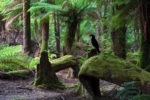


Mount Field National Park is one of the best places to experience Tasmania’s magical mossy temperate rainforest. And it is surprisingly easy to explore. It is only about 70 kilometres from Hobart, and much of its best-known rainforest scenery is concentrated in the lower section of the park, where Russell Falls, Horseshoe Falls, Lady Barron Falls and the Tall Trees can be combined into a single 6-kilometre walk.
Planning Your Visit to Mount Field National Park

How much time do you need at Mount Field National Park?
You can easily explore the lower section of Mount Field in half a day. The 6-kilometre Three Falls Circuit takes around 2–2.5 hours to walk, but I would allow 3–4 hours to stop at the waterfalls, explore the Tall Trees and take your time in the rainforest. It is an easy day trip from Hobart.
If you have less time, Russell Falls is only a short walk from the Visitor Centre. You can continue uphill to Horseshoe Falls without completing the entire circuit.
If you also want to explore the alpine section around Lake Dobson, allow a full day or consider making a separate visit. Lake Dobson is another 16 kilometres from the Visitor Centre along a winding gravel road.
What’s the difference between the Russell Falls and Lake Dobson areas?
Mount Field has two quite different areas to explore. The lower section around the Visitor Centre is the place to experience the park’s temperate rainforest, waterfalls and towering swamp gums. This is where you’ll find Russell Falls, Horseshoe Falls, Lady Barron Falls and the Tall Trees.
Lake Dobson is higher in the mountains, about 16 kilometres beyond the Visitor Centre. The landscape here is alpine, with tarns, moorland and different vegetation. This is also the part of Mount Field to explore if you are visiting in autumn (usually late April) specifically to see the turning of the fagus – Tasmania’s only deciduous tree. I came to Mount Field hoping to see the fagus turning, only to discover that fagus trees are found only at higher elevations, not in the rainforest around Russell Falls.
Do you need a Parks Pass for Mount Field National Park?
Yes. You need a valid Tasmania Parks Pass to enter Mount Field National Park. You can purchase the pass at the Visitor Centre or buy it online.
Can you visit Mount Field National Park on a day tour?

Yes, you can visit Mt Field on a day tour from Hobart. I’ve done this tour, and it’s a great and easy day out.
The tour includes the entire walk I describe below and a visit to the wonderful Bonorong Sanctuary where you can see rehabilitating and resident Tasmanian wildlife, including Tasmanian devils. If your Tasmania itinerary doesn’t include wildlife-rich places like Cradle Mountain or Maria Island. Bonorong is a particularly good opportunity to see some of Tasmania’s native animals up close.
It is also the only place I’ve ever seen an albino pademelon (not to be confused with albino Bennett’s wallabies of Bruny Island).
What facilities are available at Mount Field
The Mount Field National Park Visitor Centre offers a range of facilities, including restrooms, a café, a gift shop, a wood-burning fireplace, and, unfortunately, some stuffed animals on display.
There is also a picnic area with tables and benches in the open grassy area next to the car park.
Three Falls Walk

The best way to experience the rainforest in Mount Field is by chasing waterfalls. The Three Falls Walk starts at the Visitor Centre and takes you through the mossy temperate rainforest to three different waterfalls, with a detour through the Tall Trees along the way.
But you don’t have to walk the entire 6-kilometre circuit to experience it. There are several places where you can turn back or take a shorter route, depending on how much time you have and how far you want to walk. I’ll point out the different options as we go.
Visitor Centre to Russell Falls

The first section of the walk follows the 1.4-km Russell Falls track, a Great Short Walk in its own right.
Starting at the Mount Field National Park Visitor Centre, the trail is well-marked and takes about 20 minutes to reach Russell Falls. But I would recommend slowing down and soaking in the sights. This is the most atmospheric patch of the rainforest.
As you step into the forest, you are immediately enveloped by the cool, moist air of the temperate rainforest. The path winds through a canopy of towering swamp gums, which are among the tallest trees in the world. These ancient giants create a serene, shaded environment, with dappled sunlight filtering through the leaves.
The understorey is rich with lush green ferns, moss-covered logs, a gurgling creek and an array of multicoloured fungi picking out of the thick carpet of moss. This mossy landscape is very similar to the forest at Lake Chisholm on Tarkine Drive in northwest Tasmania. It has the same ‘fairytale woods’ atmosphere.
Glow Worm Grotto

Just before you reach the falls, you’ll pass by the sign for Glow Worm Grotto on your left-hand side. The grotto is a spectacular hidden gem, but there is a catch. To see the glow worms, you need to come back at night.
The small grotto is just a rock overhang with some jumbled fallen trees next to the trail. It doesn’t look like much during the day. But after dark, the glow worms light up the rock face like a starry sky.
As always, when visiting glow worm colonies, the red torch is best. At the very least, don’t shine your light on the insects. Not only will it prevent you from seeing them, but it will also disturb the glow worms. I have a guide to photographing glow worms if you are keen to take some snaps.

As you continue past the Glow Worm Glen, you’ll hear Russell Falls before you see it. It is a beautiful tiered cascade that tumbles down over multiple levels of dark volcanic rock. The falls are much taller than I realised; you just can’t see the top tier very well through the thick forest.
As you view the falls, keep one eye on the ground. We saw a superb lyrebird here.
Russell Falls to Horseshoe Falls

From Russell Falls, one trail runs back to the Visitor Centre via an alternative route and another to the second waterfall. Continuing to Horseshoe Falls, the trail starts to climb uphill along an elevated walkway.
There are 237 steps to climb on this walk, but if you take it easy and slow down to appreciate the incredible scenery around you, you won’t even notice the climb – it’s quite gentle. Although, if you are not a fan of climbing stairs, keep in mind that the trail from Lady Barron Falls, at the end of the walk, involves 270 steps on a pretty steep set of wooden stairways.

Just before the walkway, we came across two adorable Tasmanian pademelons who seemed to be very fond of each other’s company.
The forest on the way to Horseshoe Falls is as atmospheric as on the Russell Falls trail. Every rock, every tree trunk, standing and fallen, is covered in thick moss.

Once you reach the top, first you’ll come to the top of Russell Falls, where the creek tumbles over the edge of the cliff. The angle is not great, but just a few meters up the creek, you’ll find the gorgeous Horseshoe Falls.
This waterfall is set slightly further back from the trail, so the view takes in more of the surrounding moss-covered landscape. This gives the falls an even more secluded and peaceful appearance. In my opinion, it is the prettier of the two, even though it’s nowhere near as well-known as Russell Falls.
Tall Trees Walk
From Horseshoe Falls, follow the trail to Tall Trees Walk – the third Great Short Walk in Mount Field National Park. The walk is a loop of approximately 1 kilometre and typically takes about 30 minutes to complete.

Here, the trail winds among enormous Swamp Gums (Eucalyptus regnans), which can reach heights of over 100 meters. The tallest tree on this walk is a whopping 79 meters tall and still growing.
These ancient giants are the tallest hardwoods and the tallest flowering trees in the world. They are so tall that strong winds often snap their tops.
As they grow, these eucalypts drop their lower branches, which explains the abundance of moss-covered tree limbs on the ground.
The wet forest is also home to some wonderful birdlife. I spotted a beautiful pink robin here, although photographing it was another matter. It restlessly flitted from branch to branch and, despite my best efforts, never stayed still long enough for a photo.
We also had flocks of yellow-tailed black cockatoos and sulphur-crested cockatoos flying above the canopy, calling noisily to one another with their screeching and croaking calls. Still not sure what excited them so much.
Lady Barron Falls Circuit

Once you finish the Tall Trees Walk, you have two options: return to the Visitor Centre via Horseshoe and Russell Falls (1.7 km) or continue to Lady Barron Falls and then to the Visitor Centre (3.7 km)
The overall Lady Barron Falls loop trail is approximately 6 kilometres, but you’ve already walked almost half of it.

The trail to Lady Barron Falls is more rugged and involves a series of steps, an elevated boardwalk, and some uneven terrain, particularly on the approach to the falls, but it’s absolutely worth it for the wild feeling this walk offers.
Lady Barron Falls, which can be viewed from a well-positioned lookout, is another multi-tiered cascade fringed by moss-covered logs and lush ferns. It’s not as impressive as the first two waterfalls, but it’s even more tranquil. And the creek-side walk is particularly scenic.

From the falls, the trail follows the creek until arriving at the start of wooden stairways. Here, you’ll climb 270 steps out of the valley – it is the steepest part of the entire walk, and it comes at the very end.
If the thought of climbing stairs makes your knees tremble, you can take this walk in the opposite direction, starting at Lady Barron Falls and returning via Russell Falls. This way you’ll be climbing down both sets of stairs, these ones and the ones at Horseshoe Falls.
Facilities in the Park

More on Exploring Tasmania
- Best Places to See Wildlife in Tasmania: My 5 Most Reliable Spots

- Tasman Peninsula Cruise from Hobart: What to Expect
- Freycinet Day Tour from Hobart: Is It Worth It?
- The Best Place to See Wild Tasmanian Devils in Tasmania – From Your Cabin
- 14 Things to Do in Stanley – Tasmania’s Prettiest Small Town
- Maria Island Wombats: Where to See Them & How to Have the Best Encounter
- Mount Field National Park: One Walk – Three Waterfalls
- How to Plan a 1-2 Week North West Tasmania Itinerary for Nature and Wildlife
- Tarkine Drive in 2 Days: Itinerary, Attractions & Wildlife
- Best Things to Do in Cradle Mountain in 2 Days: Walks & Wildlife