The Clouded leopard is one of the most beautiful wild cats on earth. As a tree-dwelling inhabitant of dense tropical forests in Asia, it is rarely seen and, until recently, rarely studied in the wild. Only in 2006 did biologists realize that clouded leopards living on mainland Southeast Asia were genetically different from clouded leopards living on the island of Borneo. Consequently, clouded leopards were split into two species: Mainland Clouded leopard (Neofelis nebulosa) and Sunda Clouded leopard (Neofelis diardi).
Today, the Sunda Clouded leopard remains one of the most difficult wild cats to see in the wild. However, with a bit of luck and determination, you can see it in the jungles of Borneo. Read on and I will tell you how. But first…
Sunda Clouded leopards facts
What is a Clouded leopard?
Clouded leopard and Sunda Clouded leopard are members of the wild cat family, Felidae. They are the most recent addition to the Big Cat family that also includes the tiger, lion, leopard, jaguar and snow leopard. Clouded leopards are considered to be an evolutionary link between the Big cat subfamily, Pantherinae and small cat subfamily Felinae.
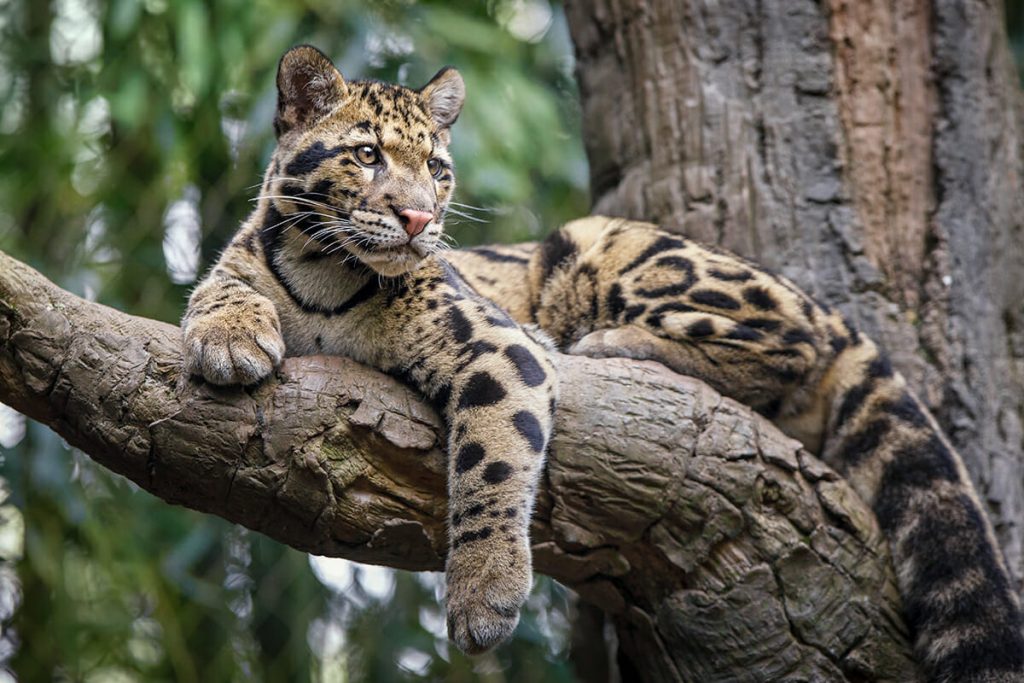
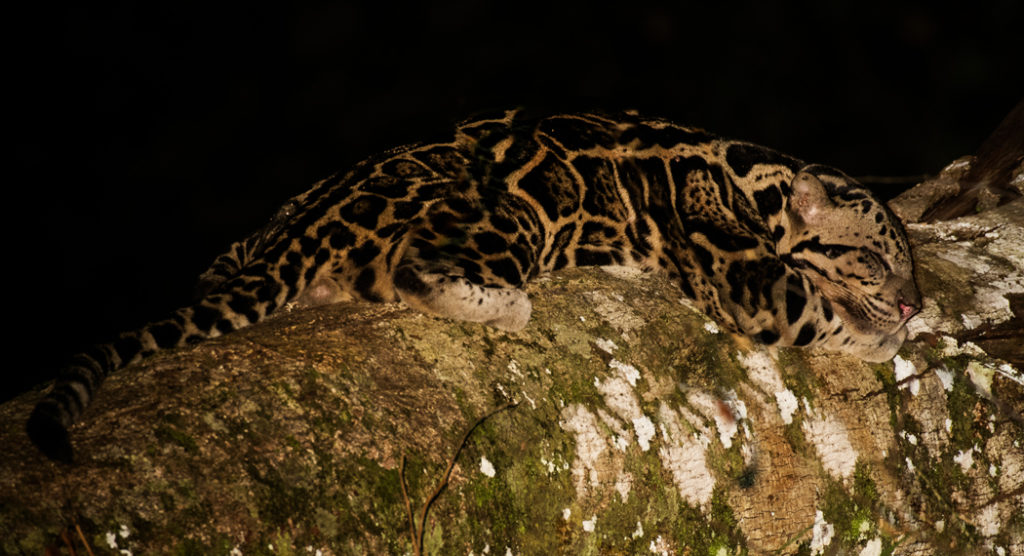
Both species of clouded leopards have exceptionally beautiful coats with large dusky-grey blotches, spots and stripes forming a clouded pattern. Their tails are almost as long as their bodies – a necessary adaptation for balancing when moving in the trees.
Another interesting adaptation for their arboreal lifestyle is their flexible ankles that allow clouded leopards to descend from trees head-first. The only other two felids that share the same adaptation are Marbled cats in Borneo and Margays in Latin America.
How long are Clouded leopard’s teeth?
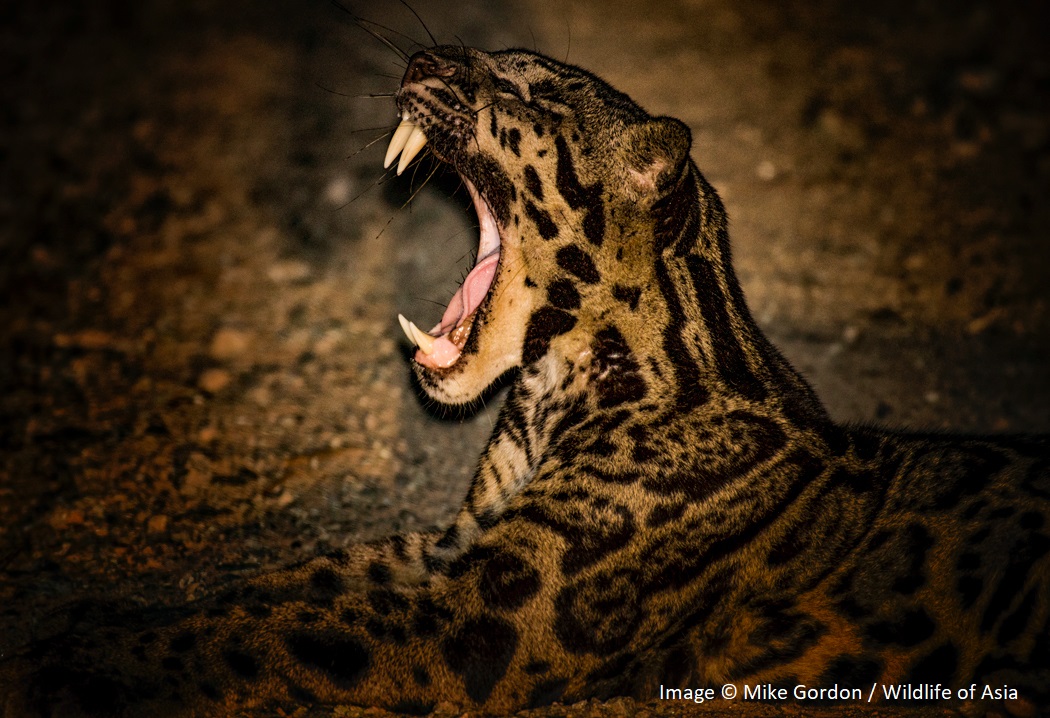
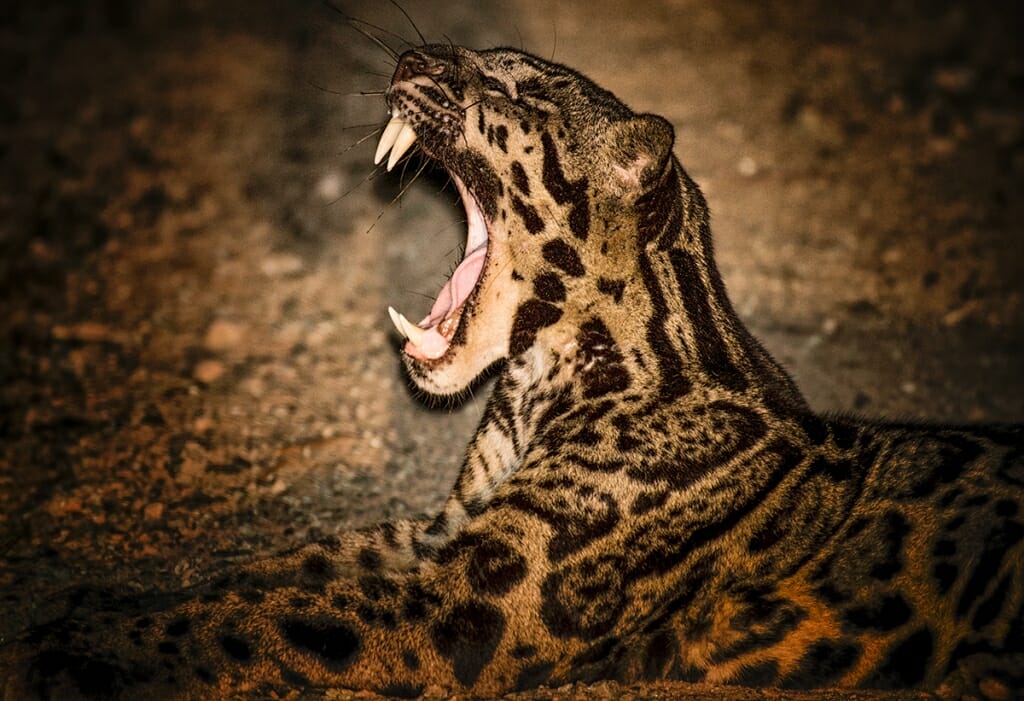
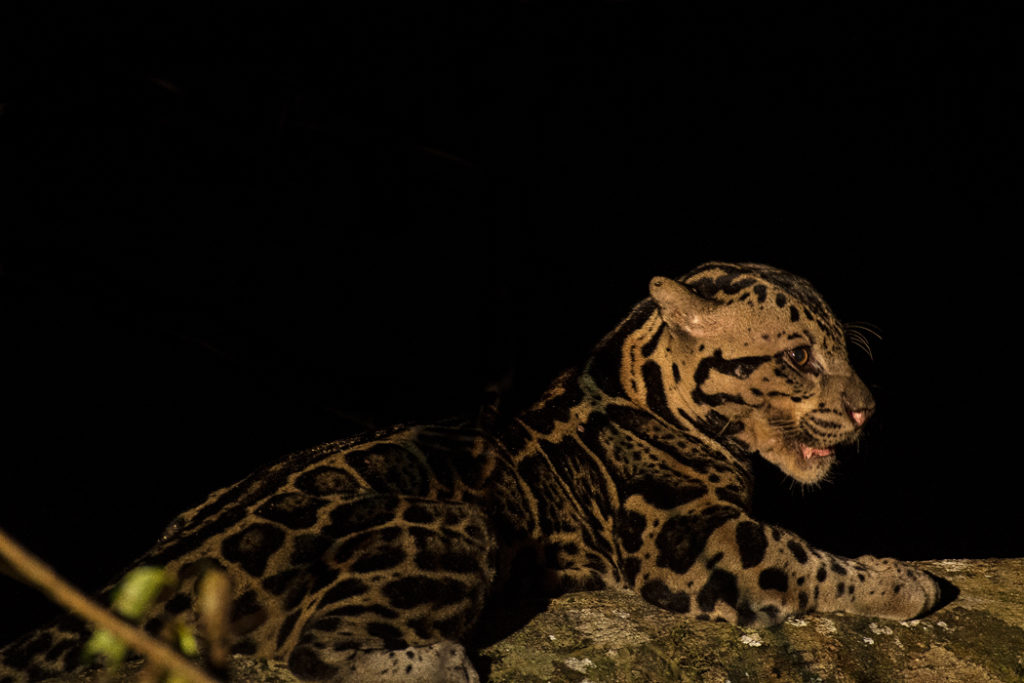
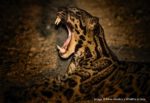
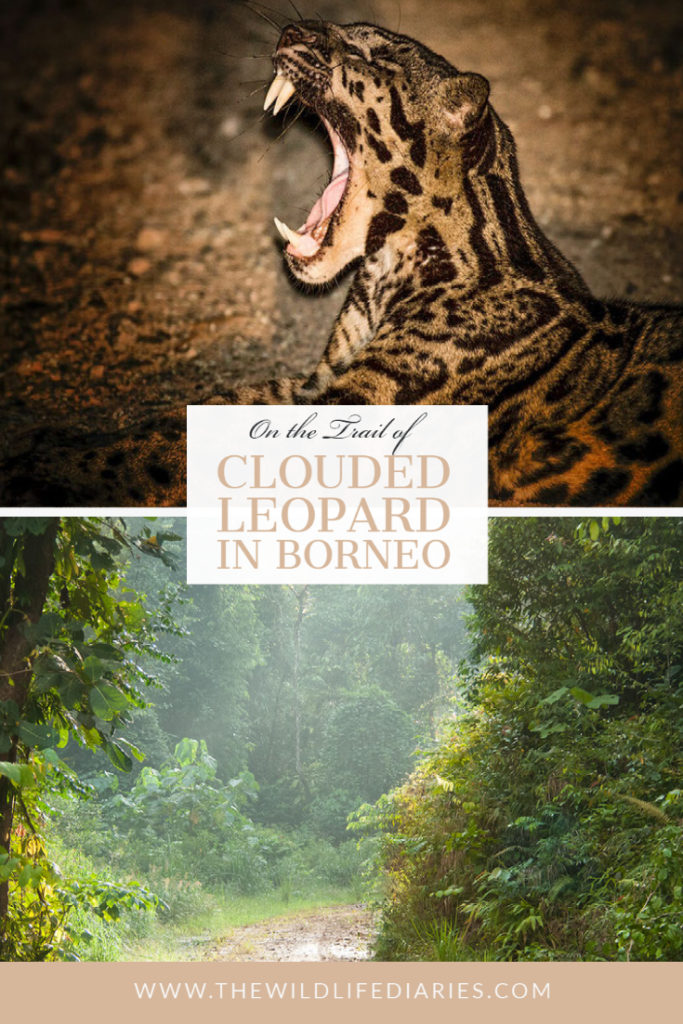
Perhaps the most unusual physical feature of the clouded leopard is the size of its teeth. It has the longest canines in proportion to body size, in the entire cat family, which earned it the name of a “modern-day sabre-tooth”. You can see those fangs for yourself in the feature image of this post, kindly provided by Mike Gordon of Adventure Alternative Borneo.
Where does Sunda Clouded leopard live?
It lives in dense forest habitats on the islands of Borneo and Sumatra. Both islands suffer high rates of deforestation and the Sunda Clouded leopard’s future is far from secure and its population is decreasing.
Sunda Clouded leopard vs Clouded leopard
The two species of clouded leopards are very similar, but on closer inspection, you will notice that Sunda clouded leopard is darker. Its fur is a dark grey while the mainland clouded leopard is more dusky tawny in colour. The clouds on Sunda clouded leopard’s coat also tend to be smaller.
Now, as promised, I share my story of looking for the Sunda clouded leopard in Borneo. If you would like a short version, check out my review of the trip in Sydney’s SunHerald. Otherwise, get comfortable and enjoy the full story below.
In search of the Sunda Clouded leopard
Riding through the night in the back of a beat-up 4WD truck converted into a makeshift safari vehicle, we are perfectly exposed to the tropical downpour that hasn’t let up for the past two hours. Soaked to the skin, we sway with the truck as it slides in the mud and thunders through the crater-like wheel ruts cut into the main road of Borneo’s Deramakot Forest Reserve.
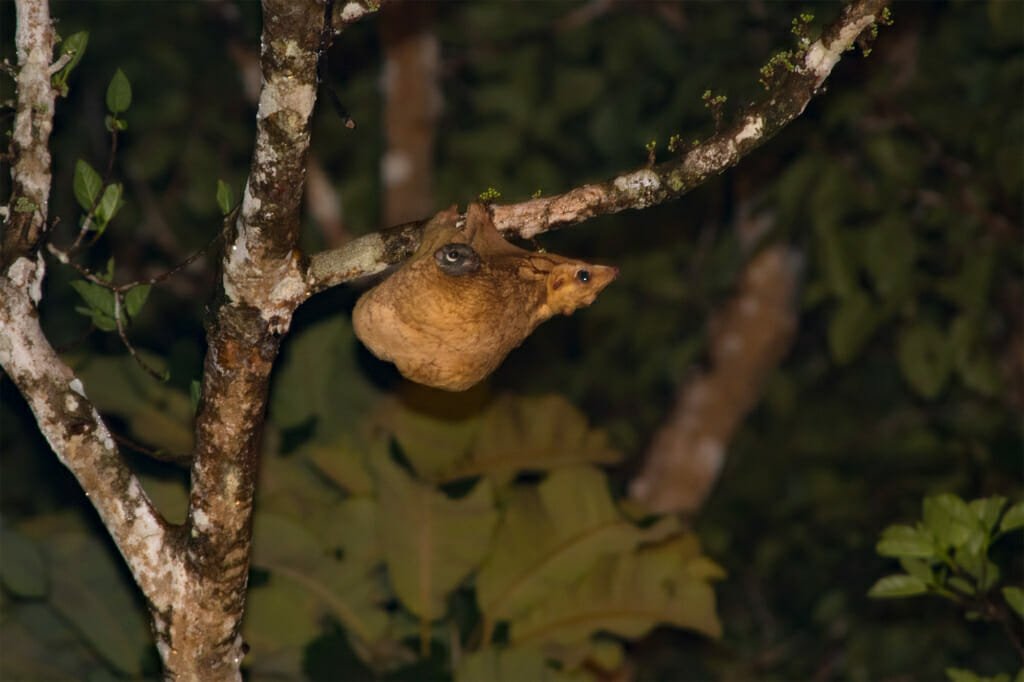
Eventually, the rain eases off just in time for us to spot the first mammal of the night – a Colugo – one of Borneo’s gliding mammals and one of its strangest. Also known as a Flying lemur, Colugo doesn’t actually fly, nor is it a lemur. But it is an excellent glider, equipped with flaps of extra skin that extend from its face all the way to its tail.
It labours onto a branch about 40 meters above the forest floor and as it hangs upside down above us, a small face pokes out of the folds of its gliding membrane. It is a young Colugo, clinging to its mother’s belly and surveying the dark jungle around it.
READ MORE: 50 Outstanding Safari Holidays Destinations Outside of Africa
– “They are so weird”, muses Duncan, one of my companions in the car.
– “Said a bunch of people who went for a drive in the rainstorm” quips Pieter, his husband.
– “And paid for it!” pitches in Steve, the fourth member of the team, and we lose ourselves in a fit of laughter.
This is the third night of our 10-day mammal-watching trip in Deramakot Forest Reserve in the Malaysian state of Sabah in Borneo and so far, it has rained every day and every night. But we are a team on a mission. We are here to see the elusive wild cats including the Sunda Clouded leopard of Borneo – a cat so rarely seen that not much is known about its life in the wild.
Led by Mike from Adventure Alternative Borneo, we ‘go nocturnal’ to match the leopard’s activity pattern: up for most of the night, asleep for most of the day.
Mike has been organizing mammal watching tours in Deramakot for three years and in that time, he has probably seen more Clouded leopards in Borneo than anyone else in the world. The sightings are not frequent – one or two a month; sometimes two in one night and other times none in more than a month, yet this is the highest success rate of anywhere else on earth.
It is counter-intuitive that a logged forest would be the best place in the world to see one of the rarest wild cats of Borneo. Yet in Deramakot, the Sabah Forestry Department seems to have attained the perfect balance between sustainable logging and wildlife conservation – an achievement recognized by the international Forest Stewardship Council. An impressive 75% of all mammals in Sabah are found in this 55,507-hectare reserve, including all five species of Borneo’s wild cats.
And so, we drive Deramakot’s roads for eight to ten hours each night, hoping that the stars will align and a Clouded leopard will emerge on the road at the exact same time as we are driving by. This trip is my second attempt to see the Sunda Clouded leopard in Borneo – a year ago I spent a week in Deramakot by had no luck spotting the elusive cat.
Borneo Pygmy Elephans
As we continue on our way, we soon hit an unexpected traffic jam. The rain has left a layer of mist in the air and out of the mist the great silent shapes of Borneo Pygmy elephants float into the muted beams of our headlights.
At first, it is business as usual: we stare at the elephants; the elephants ignore us, as they spill into the roadside vegetation around us. Then, a young female becomes obviously interested in us. Flaring her ears and bobbing her head up and down, she walks towards us dancing from one foot to the other like a Haka war dancer. Caught in her own excitement, she turns around mid-step and continues walking towards us bum-first, turning her bobbing head back to see where she is going.
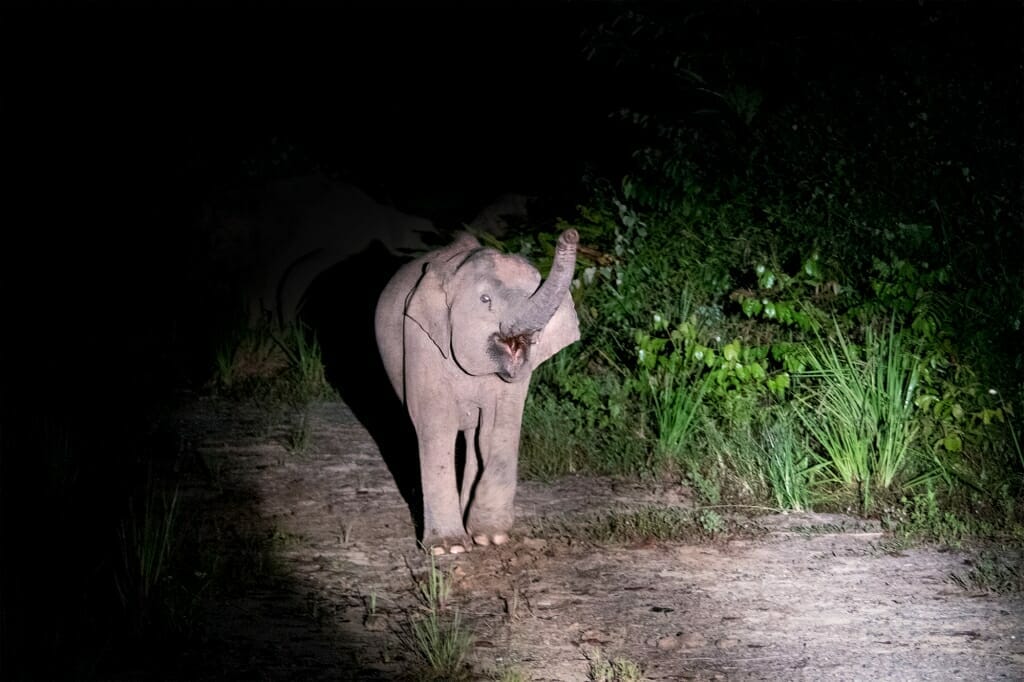
She almost touches the front bumper of our truck with her great leathery bottom before quickly walking away, as if she is afraid to get in trouble with the adults. She needn’t have worried; the adults pay no attention to her antiques. The only sign of annoyance they display is a bout of loud trumpeting when we inch our way past the herd.
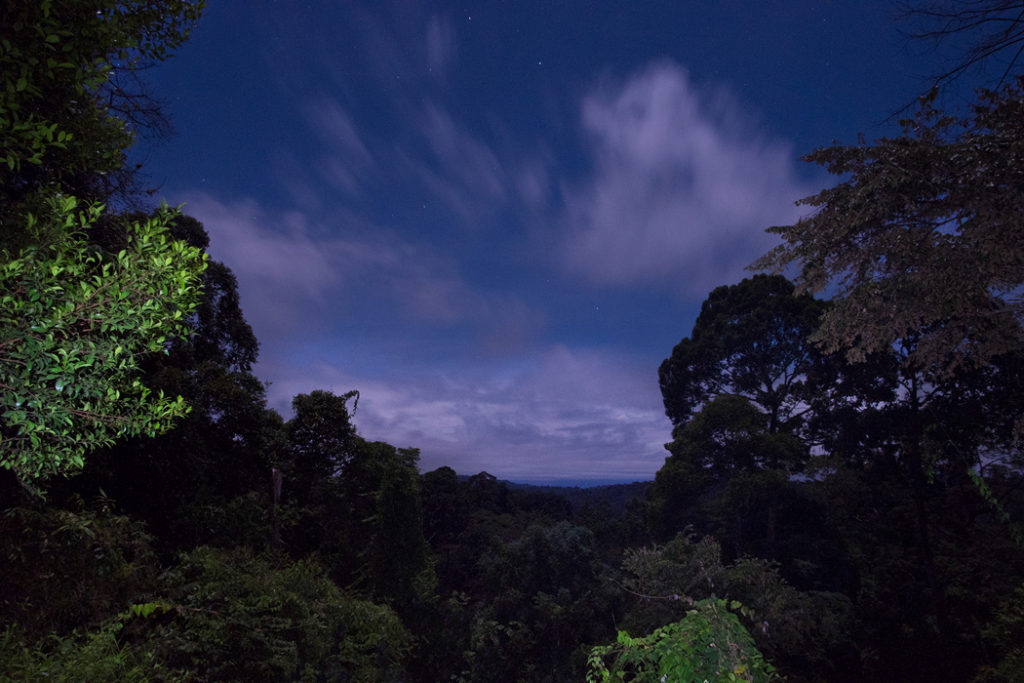
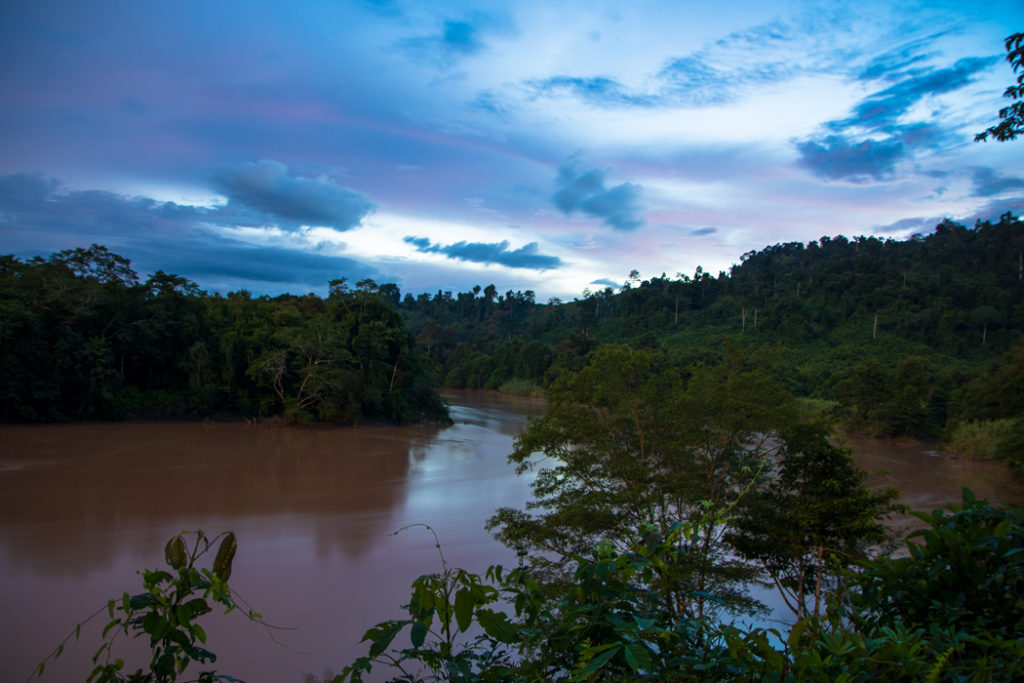
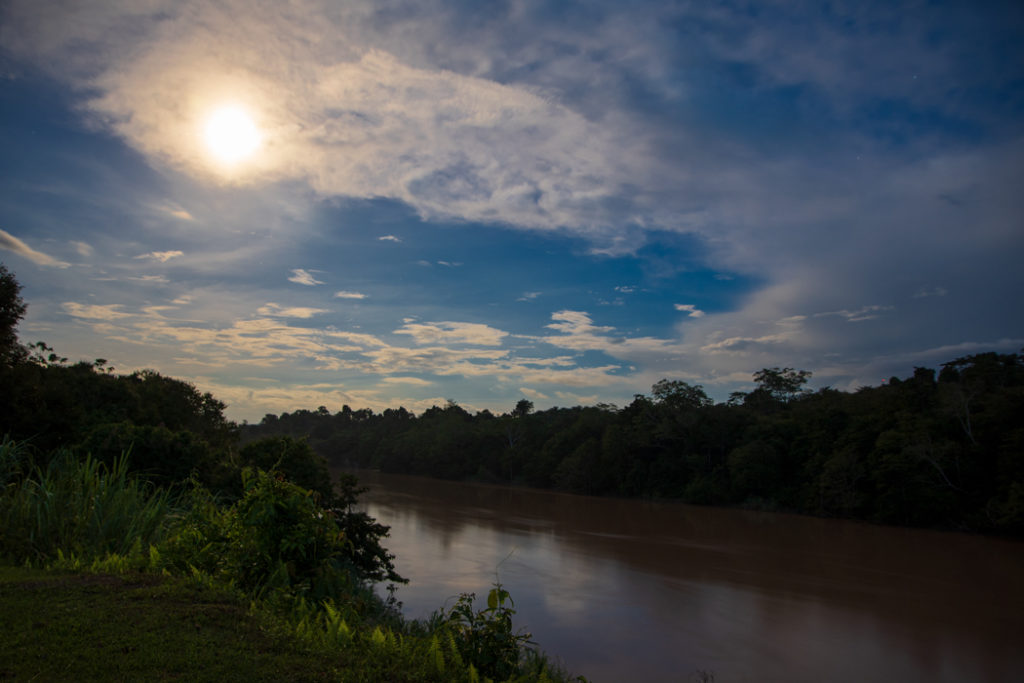
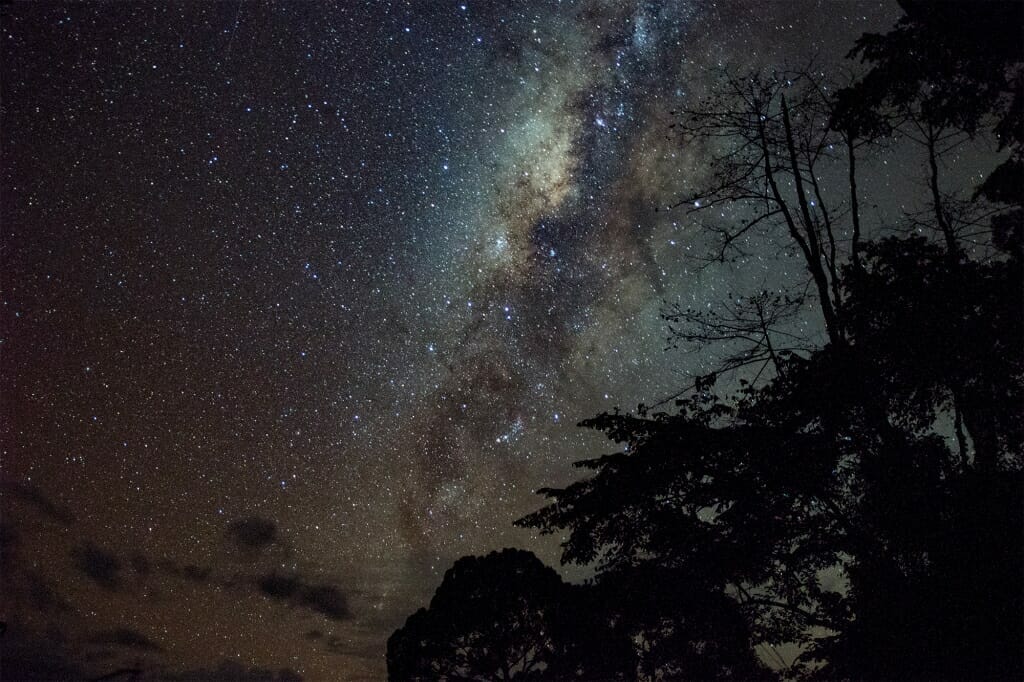
To break up the long nights on the road we stop for tea and coffee breaks. During these breaks, Mike gives me tips on astrophotography for beginners. He is an excellent teacher and within a few nights, I capture my first image of the Milky Way during a brief moment of clear sky.
Sunda Leopard Cat
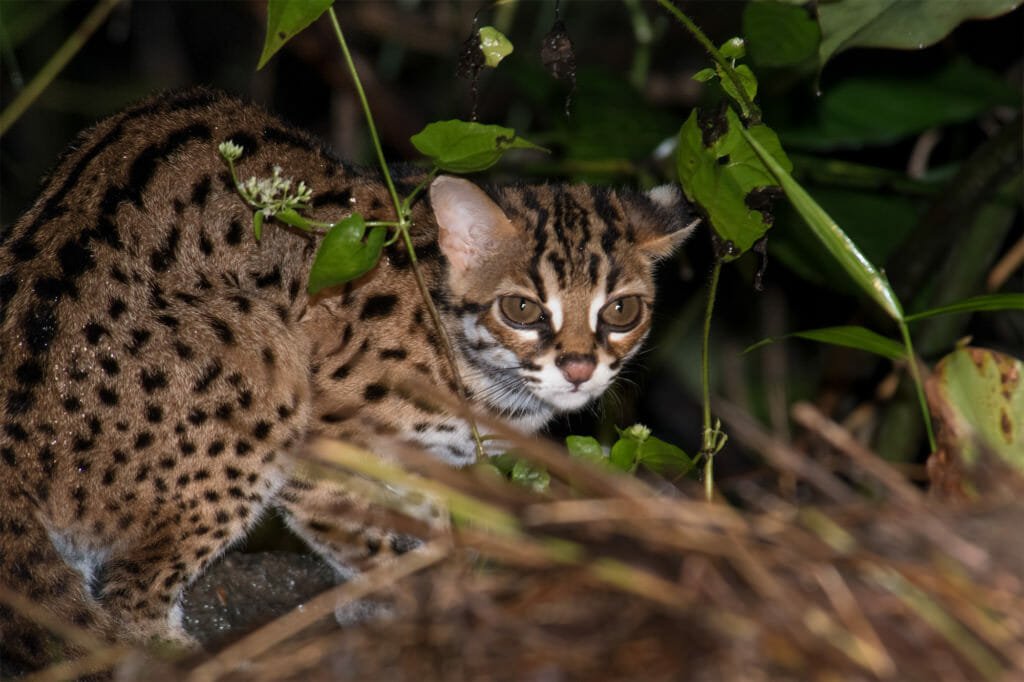
On the way back to camp, we spot the first of Borneo’s wild cats – the dainty little Leopard cat sitting on a mud bank beside the road, its coat glistening with droplets of rain. Steve proclaims his pet theory, that cats often emerge onto the road to dry off after heavy rain, and I desperately hope to see a drenched Clouded leopard to prove him right.
Every night in Deramakot runs to a different script. One night turns into the night of gliding locomotion in action as we first watch a Pygmy flying squirrel glide across the road, and then a Gian Red flying squirrel soar across a wide gap in vegetation.
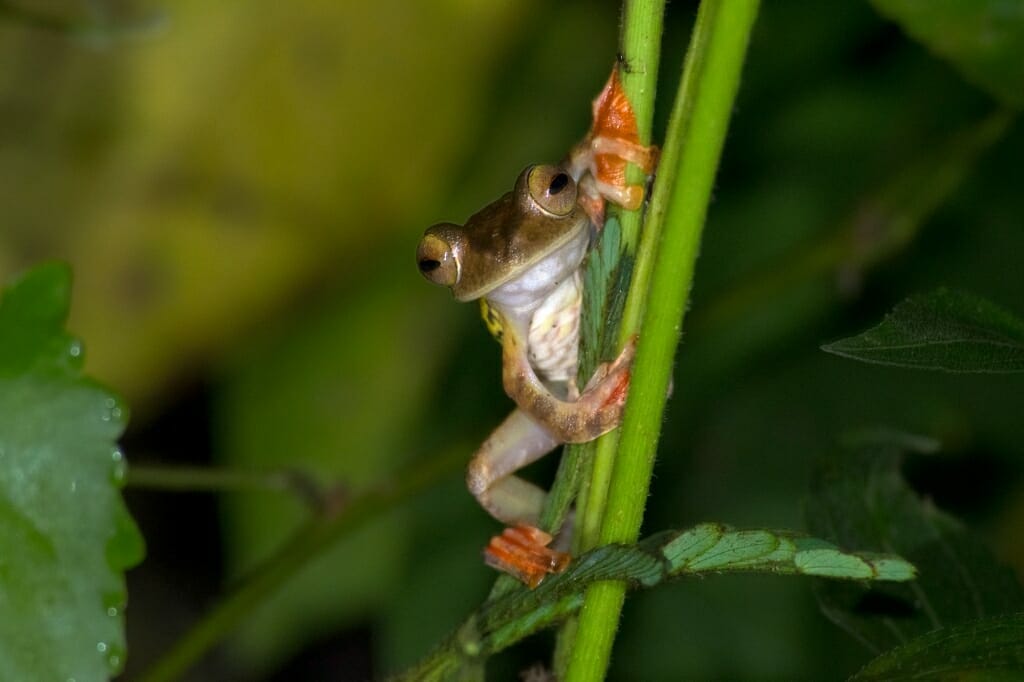
Even frogs have taken to the sky in Borneo. We find some of these flying amphibians – Harlequin flying frogs, in a roadside puddle during the coffee break.
Another night, we spot an unusual eye-shine in a distant tree and for the longest time, we can’t see what it is. “You know the rule”, jokes Mike, “if it takes more than five minutes to work out what it is, it is probably a Binturong”. And sure enough, the animal finally pokes its face through the canopy and it is the big-eyed and pointy-nosed face of a Binturong.

Sunda Clouded leopard, at last!
On Duncan and Peter’s last day in Deramakot, we head out at 2 pm – early morning in our nocturnal world. Driving to the sound of Borneo Gibbons song, we come across a giant snake slithering across the road. Impressed by its formidable size, we get busy identifying it from photographs to see whether it was a King Cobra or a Rat Snake.
“Clouded leopard!” Mike’s urgent whisper comes like a bolt out of the blue. The truck lurches to a sudden stop and we scramble out still too shocked to fully comprehend what is happening.
I follow Mike at a ninja trot a for a couple of meters up the road, crouch down, look in the direction he is pointing and see the back end of the most exquisitely beautiful cat. It is walking into the thick vegetation on the side of the road, it’s exceptionally long tail held off the ground and coiled at the end.
As it walks higher up the slope, it turns sideways and suddenly I see the entire animal – its beautiful feline face and the sharply defined black clouds on its velvety grey coat.
When the cat disappears out of view, I realize that I have been holding my breath during the entire encounter. For a while everyone is silent, and then as if on cue we explode in adrenaline-filled excitement, shaking hands with Mike and sharing our observations. “The head was small, there were no bits under the tail” – it was a girl. A smallish one. A young female. What was she doing walking around in the middle of the day?
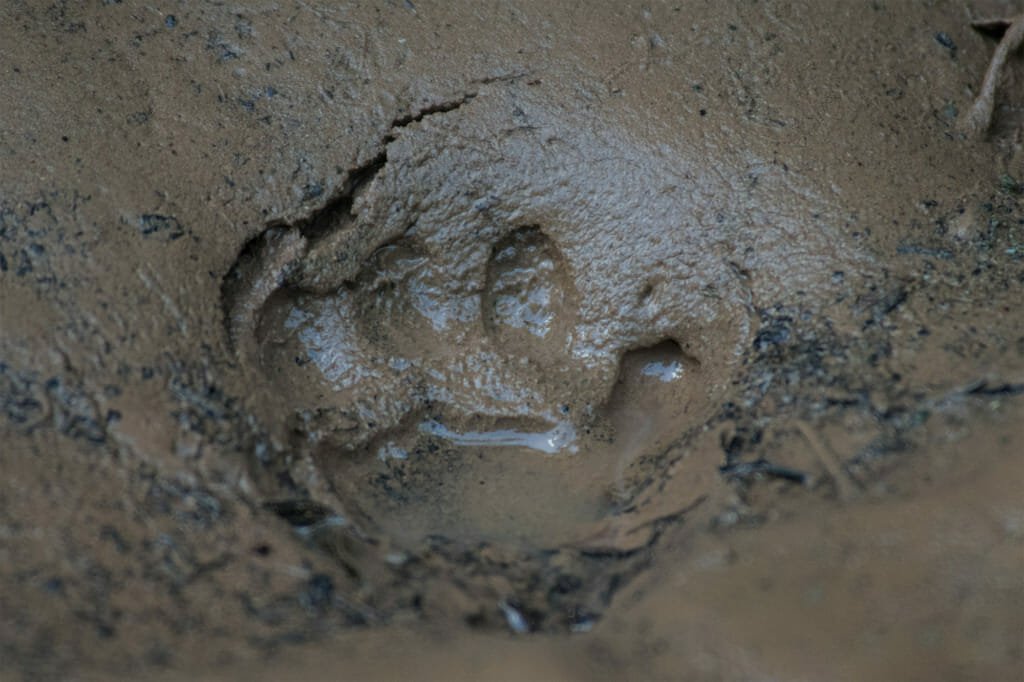
I stare at the footprint she left in the mud and realize that it has taken me a total of 21 nights in the field to spot the Sunda Clouded leopard, in an encounter that lasted about 30 seconds. But it is the 30 seconds that I will remember for the rest of my life.
The only downside to such an unexpected encounter was that I dind’t have a chance to take any photographs of the exquisite cat. Thankfully, Mike was happy to share a few images from his immense photo archive.
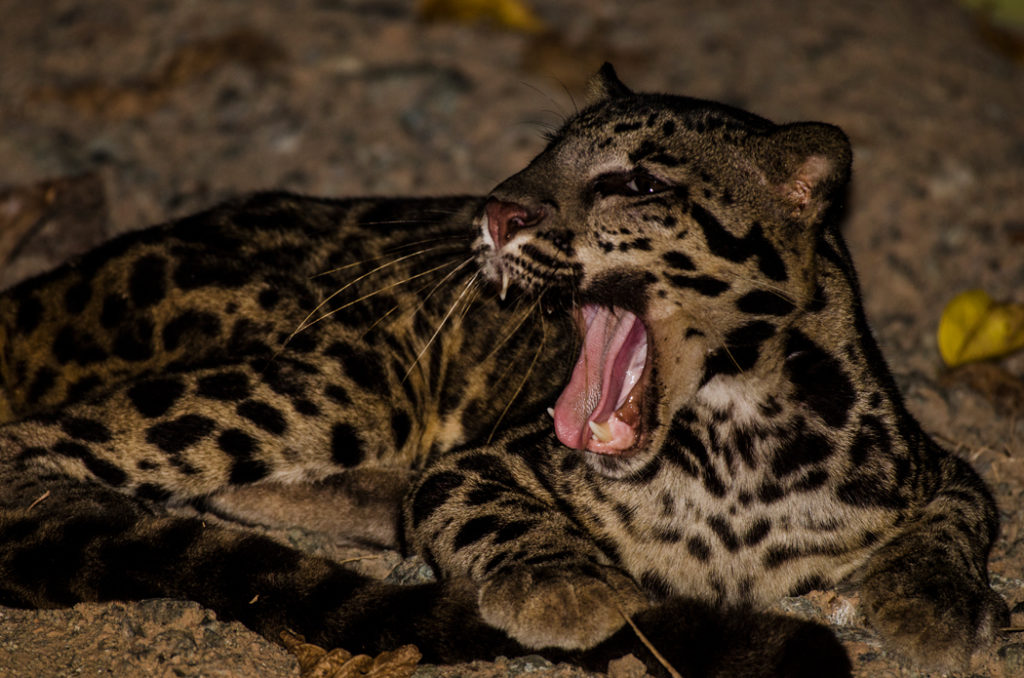
Further down the road, we come across the elephants again and the war-dancing youngster is only too happy to put on an encore performance for us. She even added an element of wardress to her routine by throwing a trunkful of grass on her back. Check out the video of this performance here.
Marbled cat… make it two!
The following night we get word that a Marbled cat has been sighted near the kilometre 10 marker. Not as well-known as the Clouded leopard, the Marbled cat is just as elusive and rarely seen. We all but inhale our dinner eager to hit the road. By the time we reach kilometre 5, the sky suddenly opens up and a solid wall of rain falls on us from above. The rain is so heavy, we can barely keep our eyes open.
“Rain is good” yells Mike over the thundering noise of the raindrops hitting the roof of the truck. “In the rain, the cat will stay put under the relative cover of the tree”.
We escape the deluge in a small shelter on the side of the road at kilometre 10 and to entertain ourselves, we count the number of seconds that pass between a strike of lightning and the consequent clap of thunder, to estimate how far away the centre of the storm is.
When the rain is reduced to a light trickle, we climb back into the wet truck, turn around on the slippery road, look up and immediately spot the Marbled cat, curled up on a branch 40 meters above us. Apart from its small size, it is so similar in appearance to a clouded leopard that an inexperienced observer could easily confuse it for its cub.
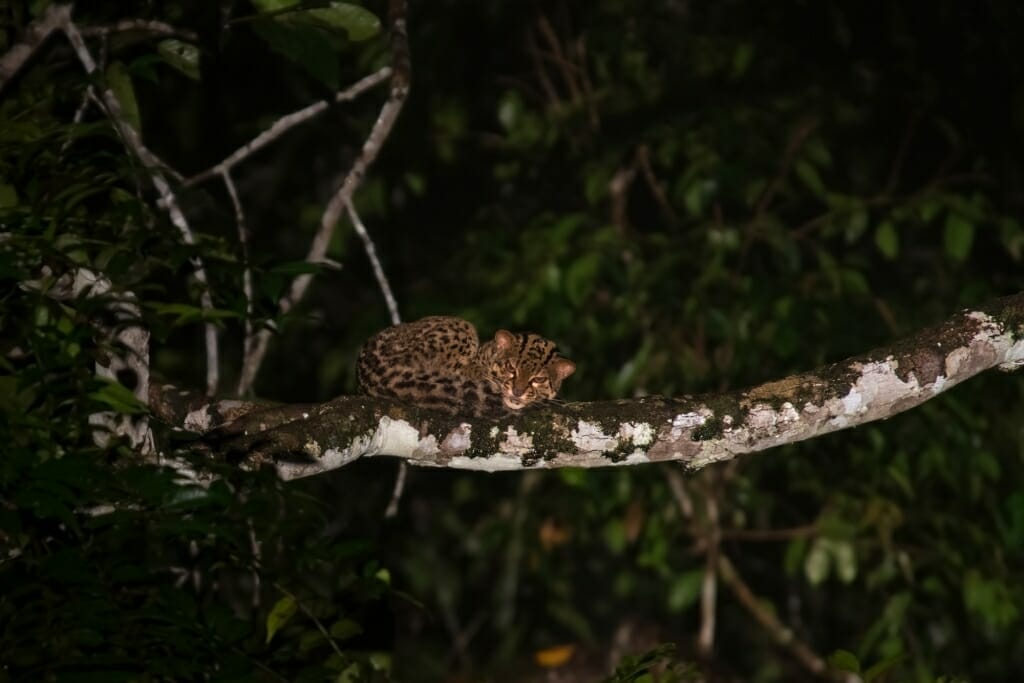
We watch the stunning cat stretch, yawn, walk along the brunch and effortlessly jump onto a higher one. This is obviously as active as the cat is going to get. It curls into a compact ball on its new perch and settles in for another snooze.
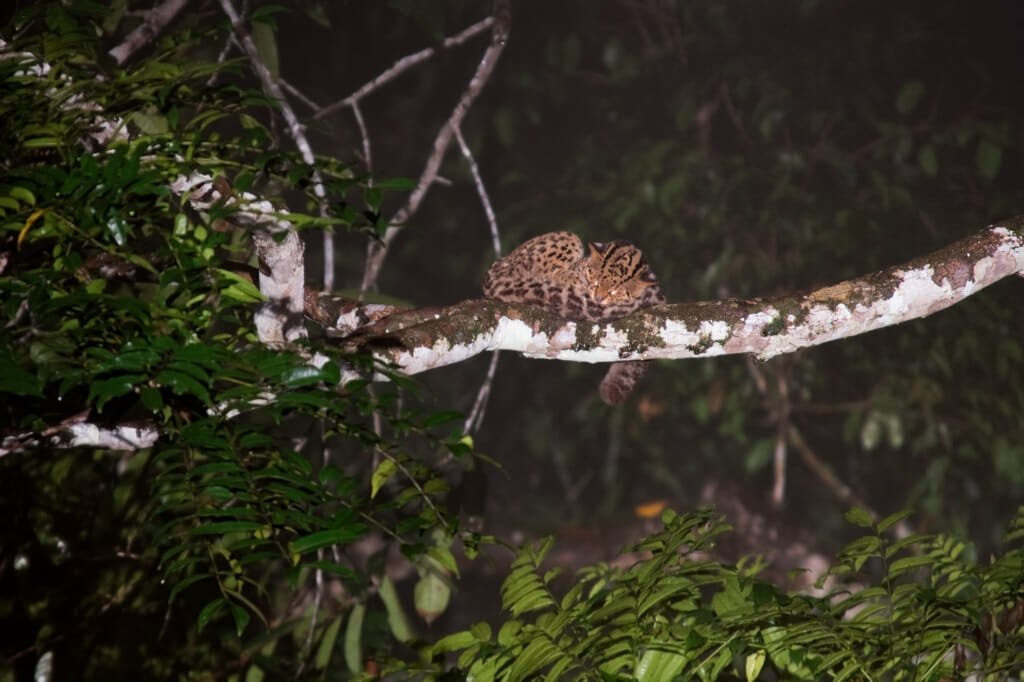
Captivated by the cat, we almost miss another eyeshine higher up in the tree and when we do check it out, we are stunned to discover another Marbled cat. Not as happy at being discovered as its neighbour on the lower branch, it slinks off into the thicker part of the canopy, leaving us guessing whether it was the parent of the younger and the more tolerant cat below.
Stars, bats and flying frogs
On my last night in the jungle, Deramakot generously reveals more of its unique inhabitants: Wallace’s flying frog, a Malayan porcupine and a wealth of different bat species.
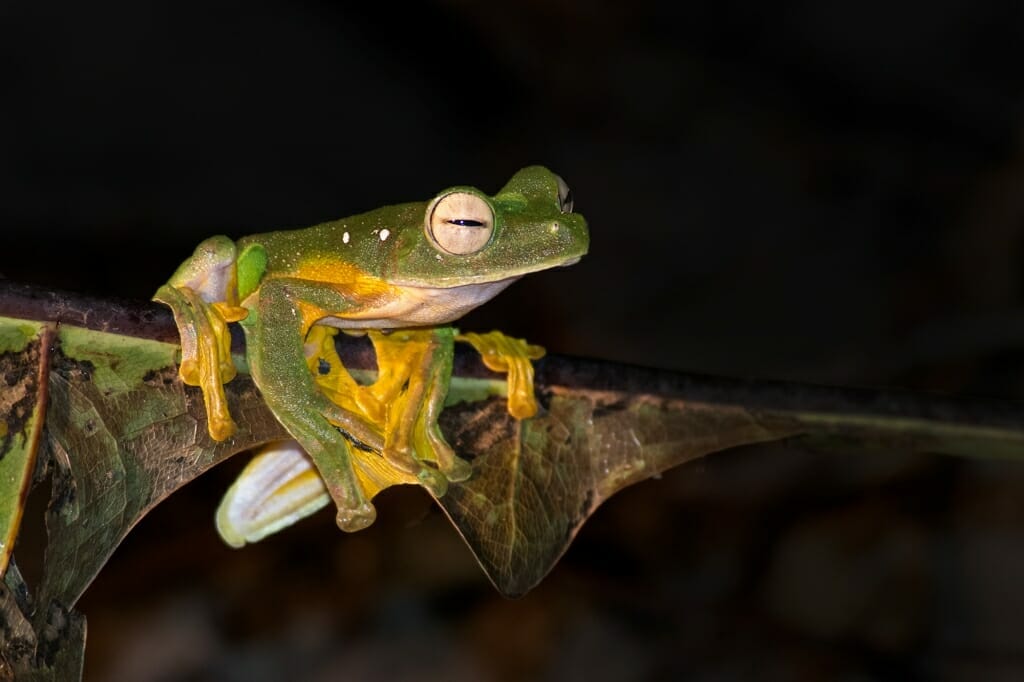
During the coffee break, Steve, our designated bat specialist turns on his bat detector and we listen to a series of clicks and claps emitted by the echolocating bats
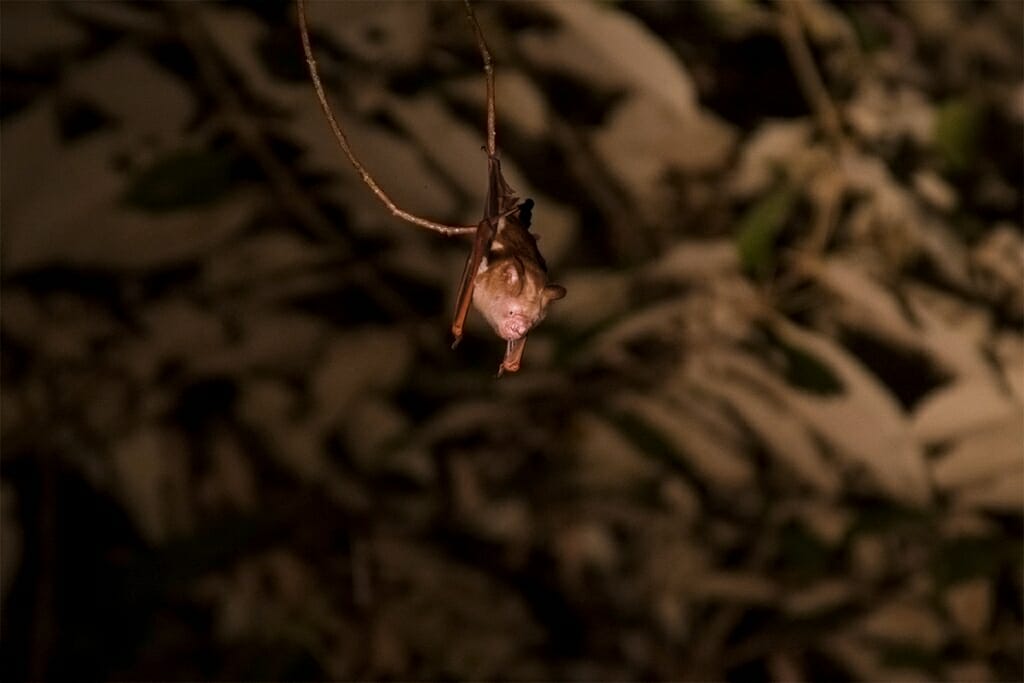
The sky above is surprisingly clear and I set up the tripod in the middle of the road for my final Astro-photoshoot.
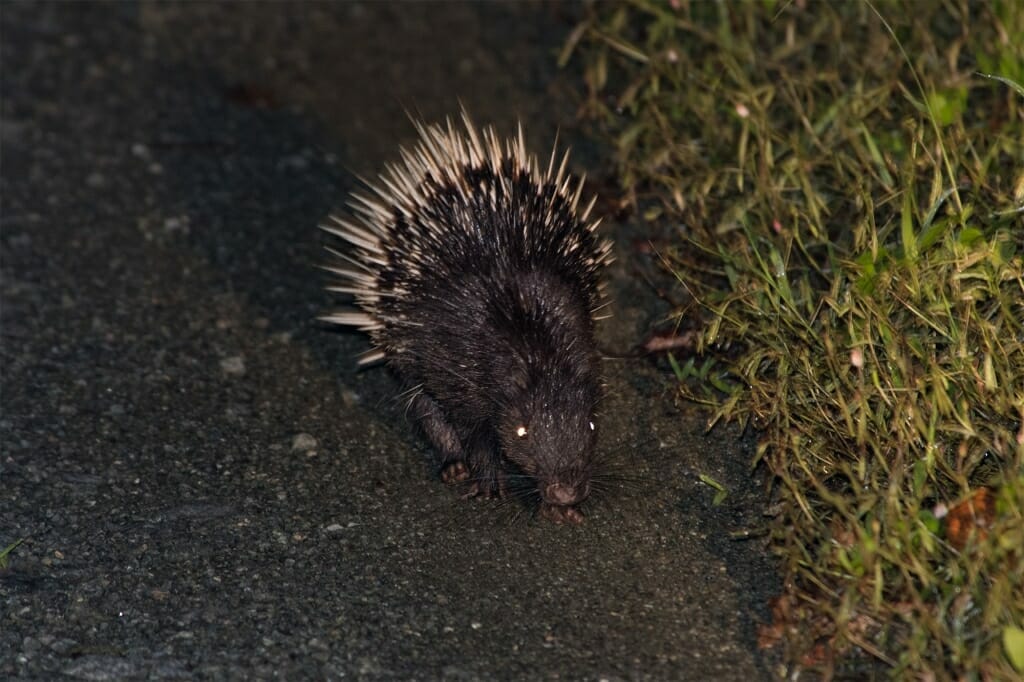
Standing ankle-deep in mud, photographing the Milky Way to the crackling sound of the bat detector I feel like I discovered the secret to happiness. I have now seen four out of five wild cats of Borneo (I saw the Flat-headed cat on Kinabatangan River earlier), and perhaps one day we will learn more about the Borneo Bay cat and will be able to find it in the wild. Dream big or not at all…
Update: Just weeks after our trip (the trip report can be found here), Mike filmed this incredible footage of a female Clouded leopard with two cubs. The female in this video looks very similar in colouration to the one we spotted on the trip.
Visiting Deramakot
Booking the tour
There are no shops or petrol stations in Deramakot, which means that you either have to bring your own 4WD, all food, and petrol with you or you can join an organized tour with an accompanying guide, a driver and a cook. Adventure Alternative Borneo was the first commercial outfit to initiate tours to Deramakot, and it still remains the best option on the market.
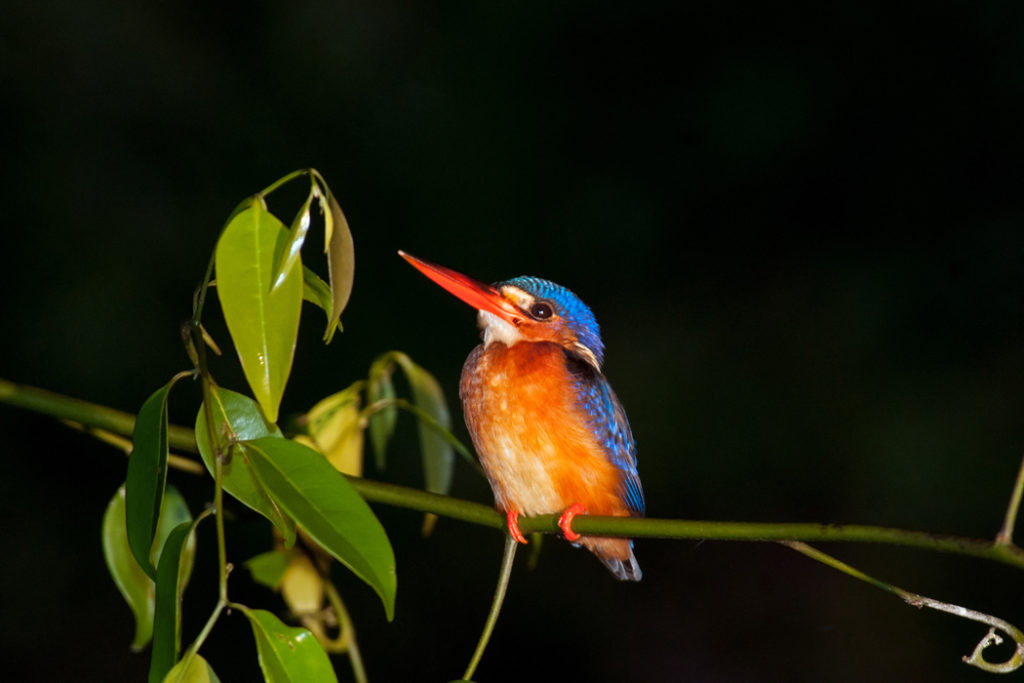
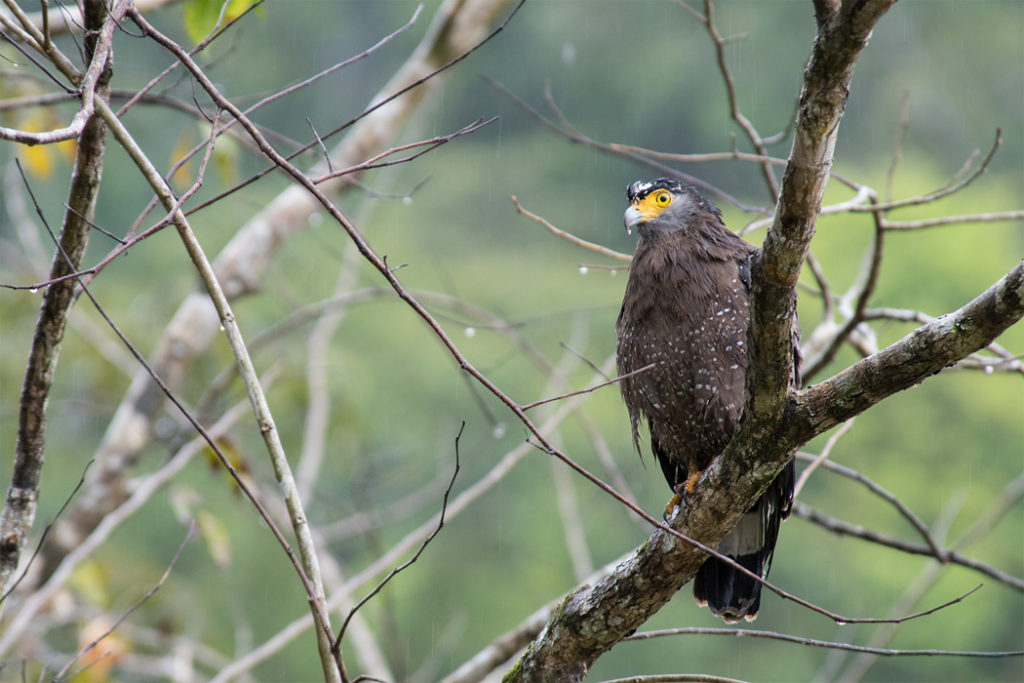
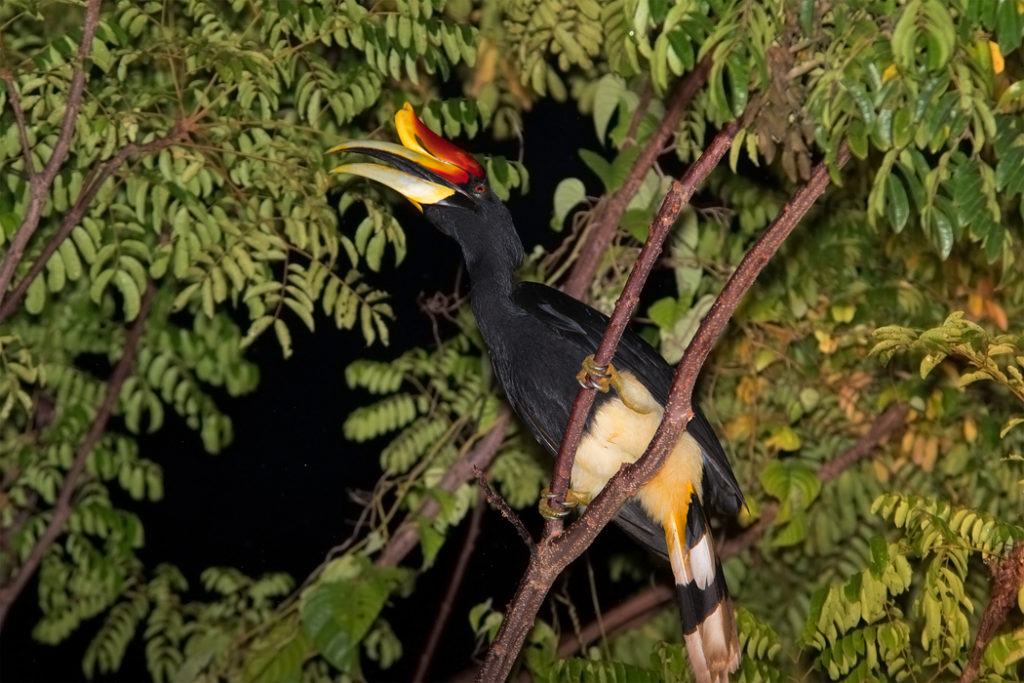
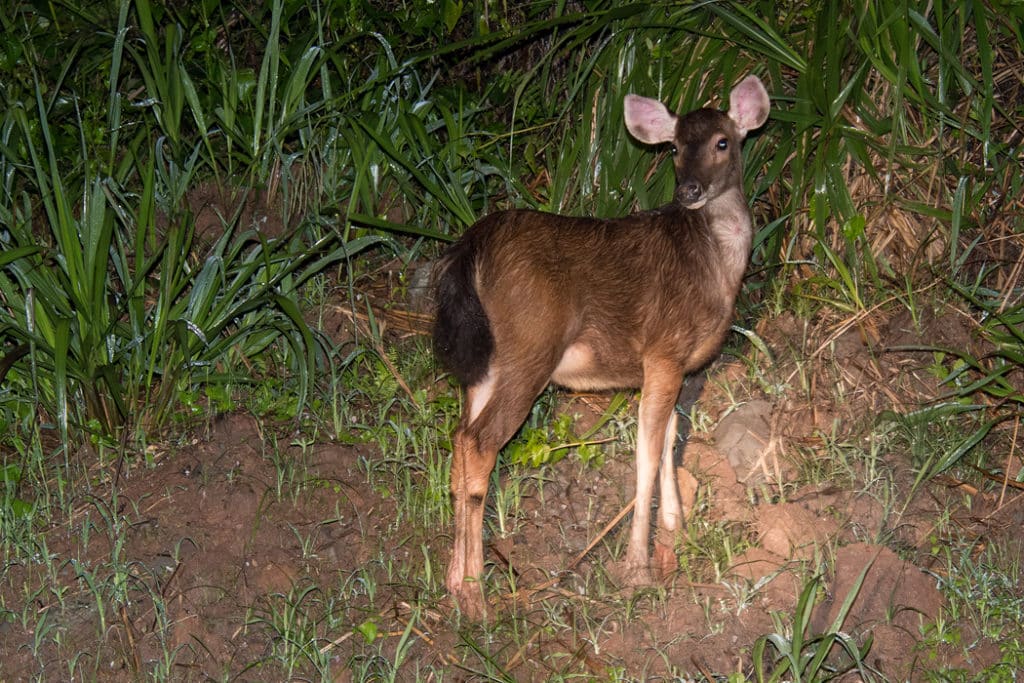
The main accommodation option in Deramakot is the three-bedroom chalets that come equipped with hot water showers and air-conditioning. The transfer from Sandakan airport or hotel is included in the cost of the tour.
Do you have any questions about visiting Deramakot or about wildlife watching in Borneo? Don’t think twice, leave a comment!
More on Borneo Wildlife
- 4 Days in Danum Valley: Ancient Rainforest and Spectacular Wildlife

- Guide to Planning Kinabatangan River Cruise in Borneo
- 28 Incredible Borneo Animals and best places to see Borneo wildlife
- On the trail of the Amazing Sunda Clouded Leopard in Borneo

- A Different Kind of Borneo Wildlife Holidays: Deramakot Forest Reserve
- Where to see wild cats in Borneo?
- On the trail of the Flat-headed cat in Borneo

Hello Margarita,
Your blog is amazing, there is no other that informs that detailed over wildlife watching. I would also like to visit the Deramakot Reserve, maybe you could share the contact details of your guide? That would be great. How did you find him? Thank you for your help.
Many greetings and good luck for new sightings, Philipp.
Thank you for dropping by and for your kind words, Philip. The best company for Deramakot tours is Adventure Alternative Borneo: https://www.adventurealternativeborneo.com/. If you can, book your tour with Mike – he is the best guide by far.
Cheers,
Margarita
Wow, thank you; this was incredible. I have always loved zoology, and the sunda clouded leopard is such a beautiful although elusive animal. The footage is fascinating and incredible, and I wish you good luck. Borneo is on the top of my bucket list. Thank you again!
I’m thrilled you enjoined it, Lauryn. Clouded leopards are gorgeous creatures.
Oh wow, this is just incredible! What stunning creatures. And I love the way you write – so evocative.
Thank you so much, Rebecca!
What an adventure! Another cool animal to spot in Borneo is the proboscis monkey – their nose literally looks like a penis – google it! Thanks for sharing :)
Yes, Proboscis monkeys are definitely something else :)