
Planning a trip to Assisi? Prepare to be swept off your feet by this town’s charming medieval ambience. There’s no shortage of things to do in Assisi, whether you stay for a day or a week.
Assisi is a town that exists outside of time. Its perfectly preserved and uniform medieval ambience envelopes you as soon as you step foot in town. So you may as well forget what century it is. For as long as you are in Assisi, you’ll be living in Medieval Italy.
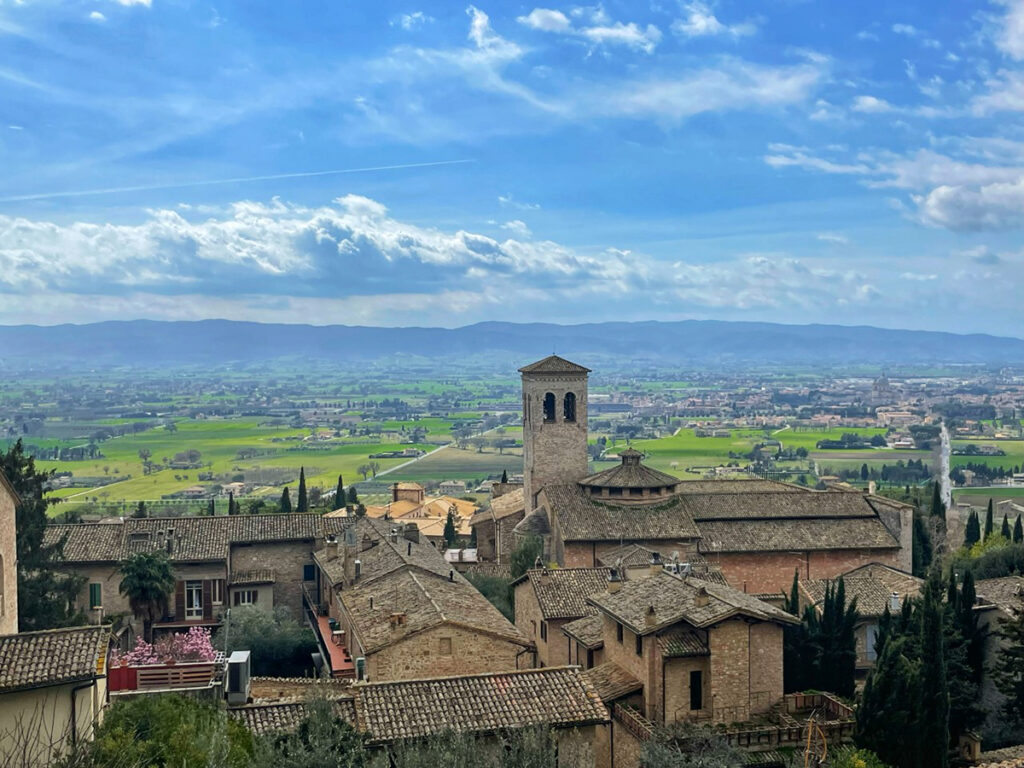
Spilling down the side of Mount Subasio, Assisi is safeguarded by two hilltop fortresses, Roca Maggiore and Roca Minore. In winter, the air is filled with the scent of wood-burning fires and the sound of ringing church bells. The pink limestone of Mount Subasio, from which many of the town’s structures and monuments are built, gives Assisi’s streets a warm glow, especially in the afternoon light.
Beyond the incredibly picturesque streets and sweeping views of the lush green Umbrian countryside, Assisi is home to what’s been called “the most beautiful house of prayer in the world” – Saint Francis Basilica decorated with frescoes by Giotto – the creative mind behind Florence’s Duomo Bell Tower. With his stunning frescoes in Saint Francis Basilica, Giotto foreshadowed the Renaissance that would come a century later.
And all this medieval splendour stands on the foundations of the Roman city of Assisium. While Assisi is mainly known as the birthplace of Saint Frances – one of the most important Catholic saints and the founder of the Franciscan Order, the town had been settled for over a thousand years before St Francis was born in 1181.
There is something for everyone in Assisi, so if you planning your next trip and wondering where to go in Italy, consider including Assisi in your itinerary.
Roman Asisium
The first inhabitants of Assisi were the Umbrians, who were replaced by Etruscans around 450 BC. And around 295 BC, Romans took over most of central Italy and established the flourishing city of Asisium on the slope of Monte Subasio.
In Roman times, Assisium was a flourishing city encircled by stone walls. Like most Roman cities, it had an amphitheatre, a forum, an aqueduct that brought fresh water from the mountain springs, and a cistern to store the water. In the third century AD, Saint Rufino brought Christianity to Assisi, was martyred for it and became the town’s patron saint.
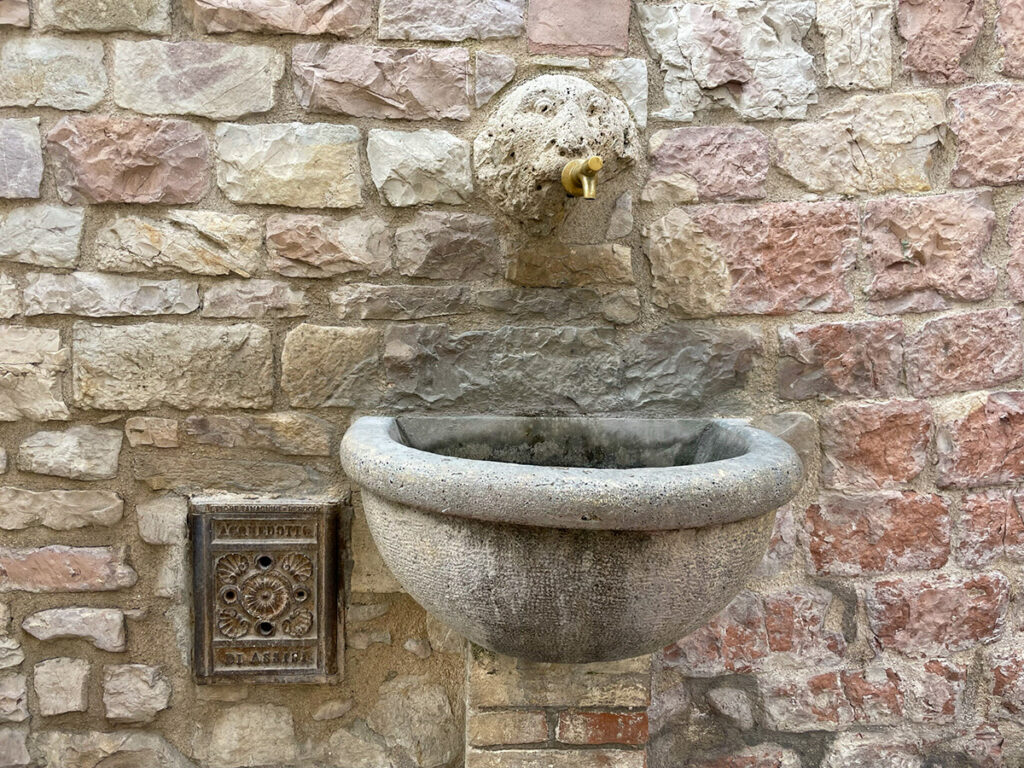
In the following centuries, many of the pagan Roman structures were converted into churches. San Rufino Cathedral, for example, sits on the foundation of the cistern. But the aqueduct still functions – you can fill your water bottle from any brass taps you’ll find around town.
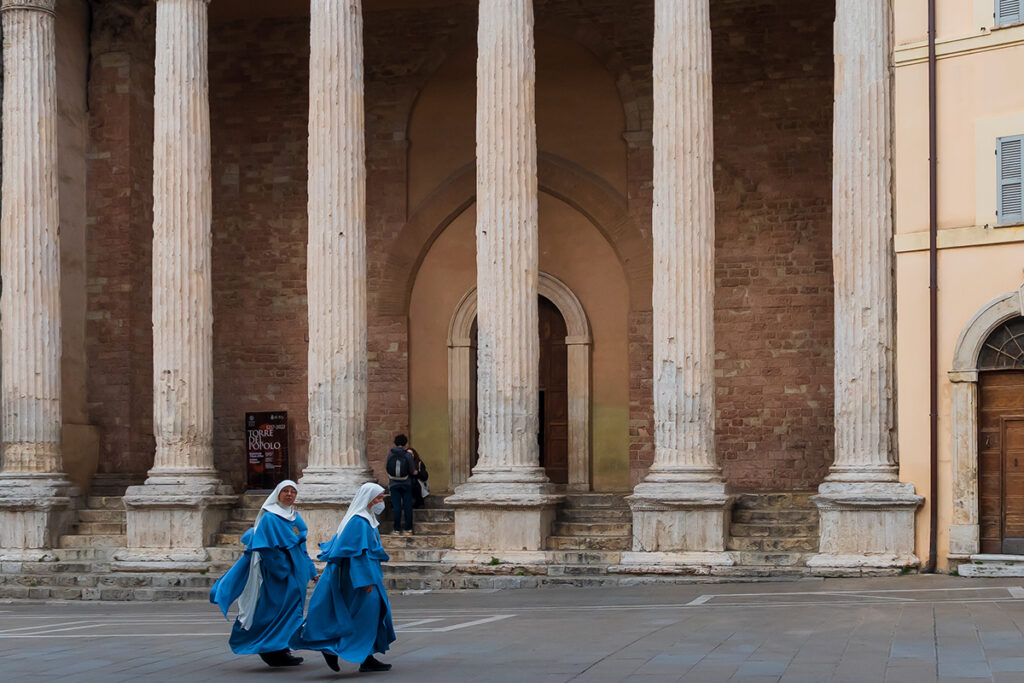
The Roman Temple of Minerva on the town’s main square – Piazza del Comune, also had been converted to a church, but its facade remained so well preserved that it is considered to be the best preserved Roman temple front in all of Italy. If you are interested in learning more about Roman traces in Assisi, you can find the details in my guide to Roman Assisi.
Medieval Assisi
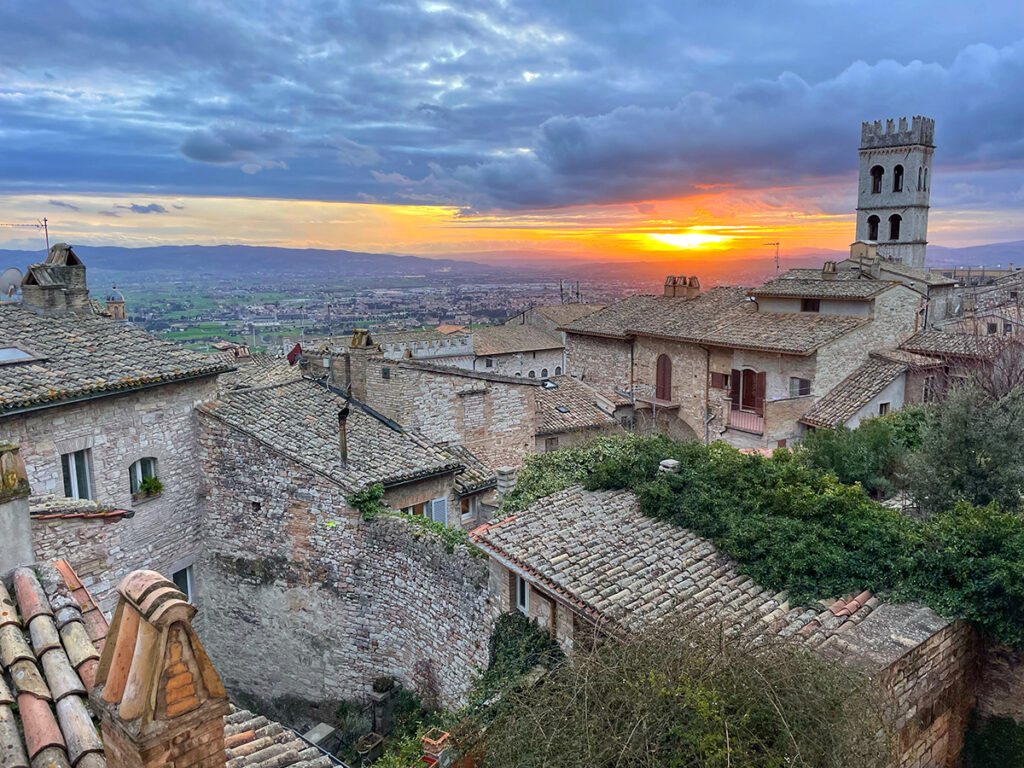
In medieval times, Assisi was a bustling wealthy town thanks to its position on the trade route between Northern Europe and Southern Italy. Until the Black Death of the 13th century arrived and killed a third of its inhabitants. The town never recovered. Ironically, the bubonic plague was the reason Assisi’s townscape remained preserved in all its medieval glory.
Things to do in Assisi
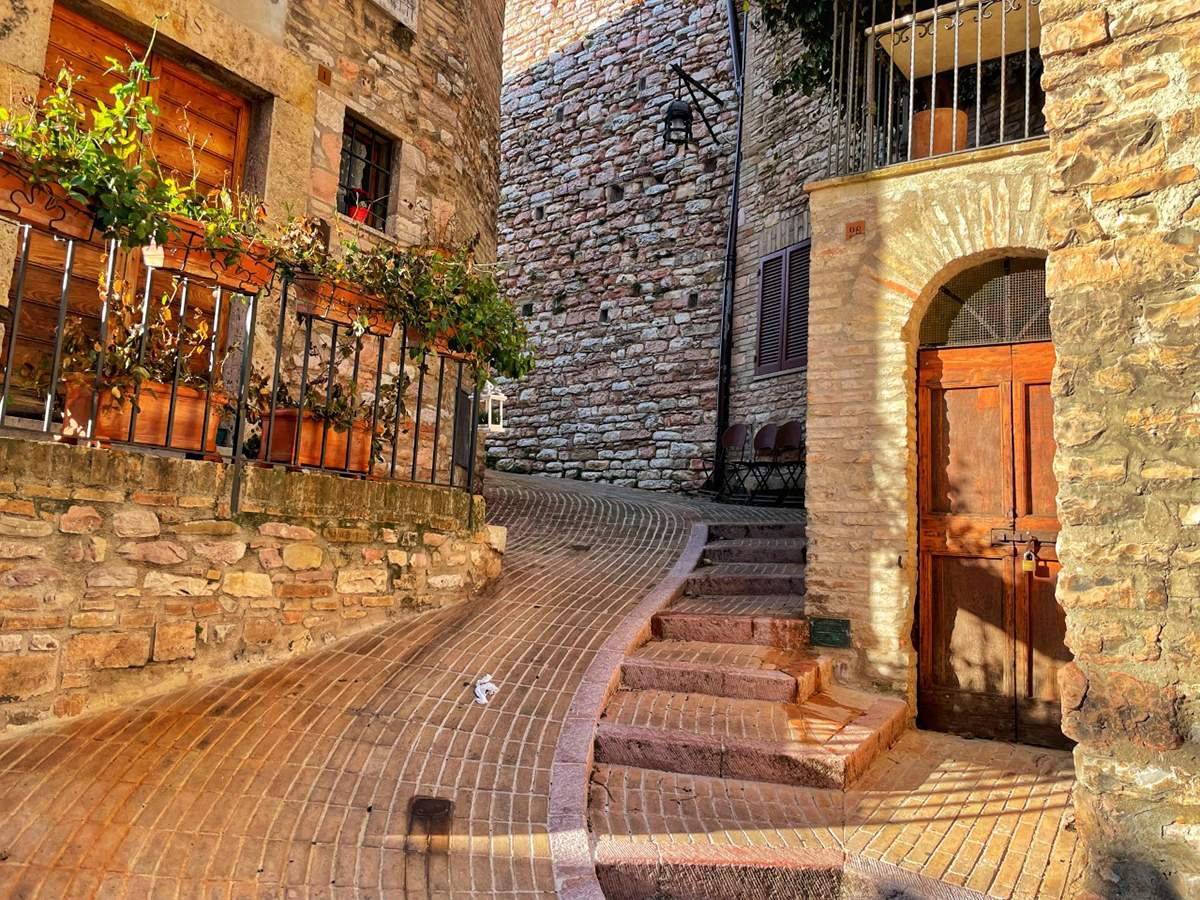
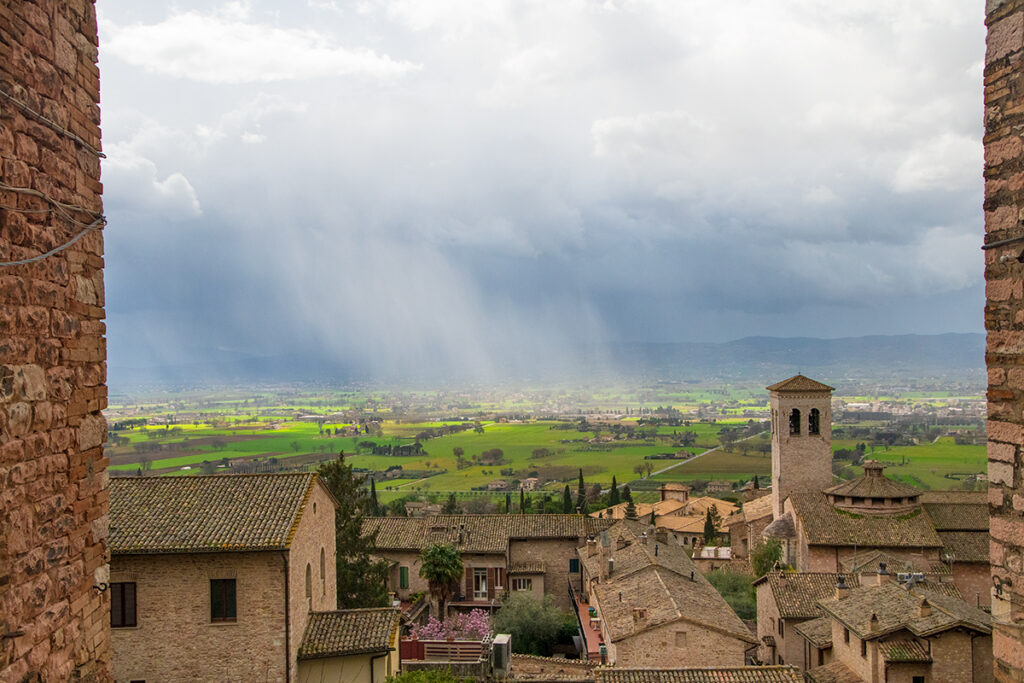
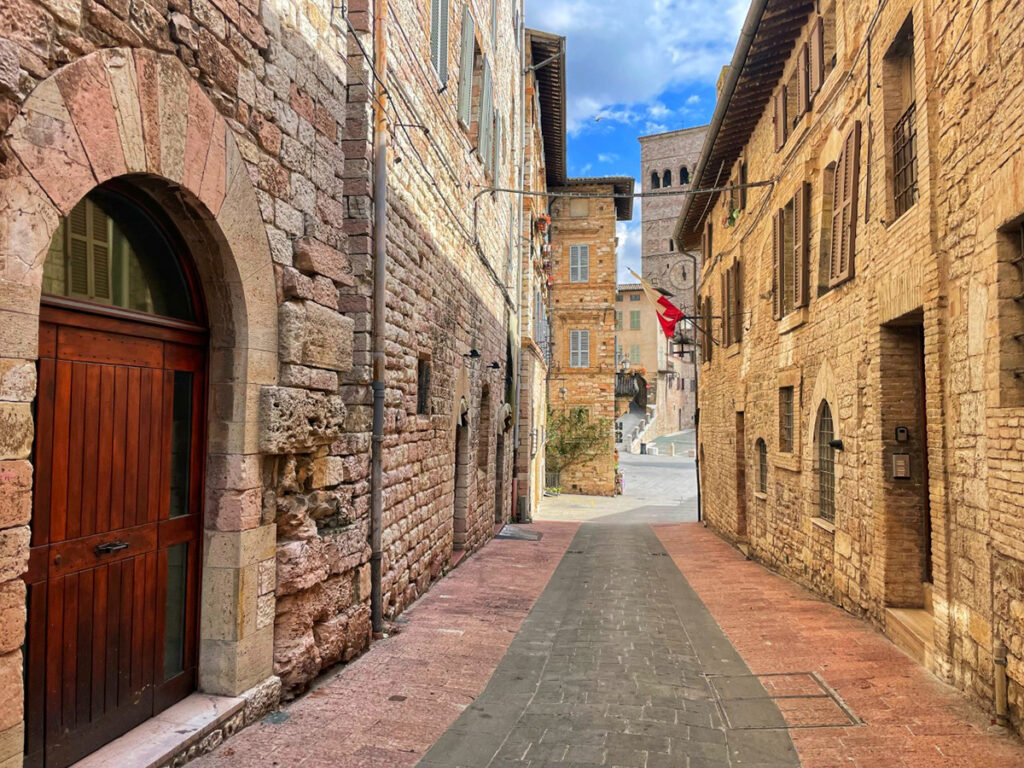
The main sites in Assisi are the three major basilicas: Saint Francis, Saint Clare, and Saint Rufino; and the Roman Temple of Minerva which was converted to a church in 1539. Enough to lure you in for a weekend in Assisi. But the charm of Assisi is found on its ancient streets that twist and turn in the most atmospherically irregular ways often opening up to stunning views of the valley of Tescio spreading below the town.
The best way to start exploring Assisi is by walking into town through one of its medieval gates. Porta Perlici near the main bus stop at the eastern end of town is a good starting point. Walk a few steps outside of town and soak in the view of both hilltop fortresses Rocca Maggiore and Rocca Minore on the opposite hills, the stone wall running all the way between them and Porta Perlici cut through the walls.
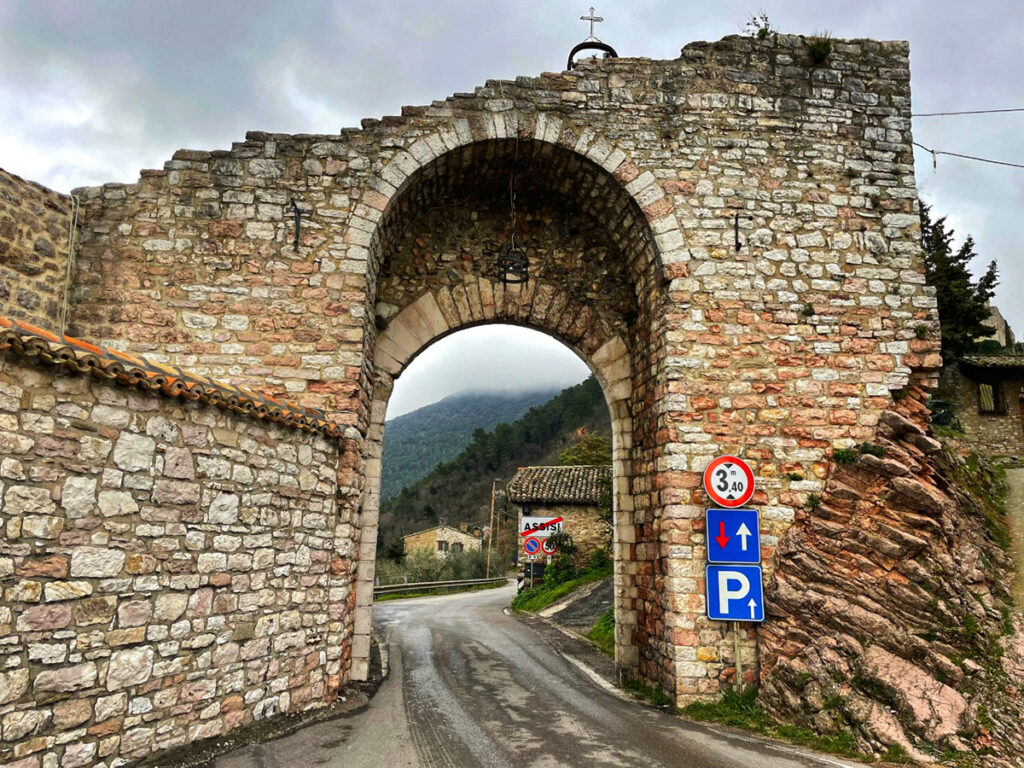
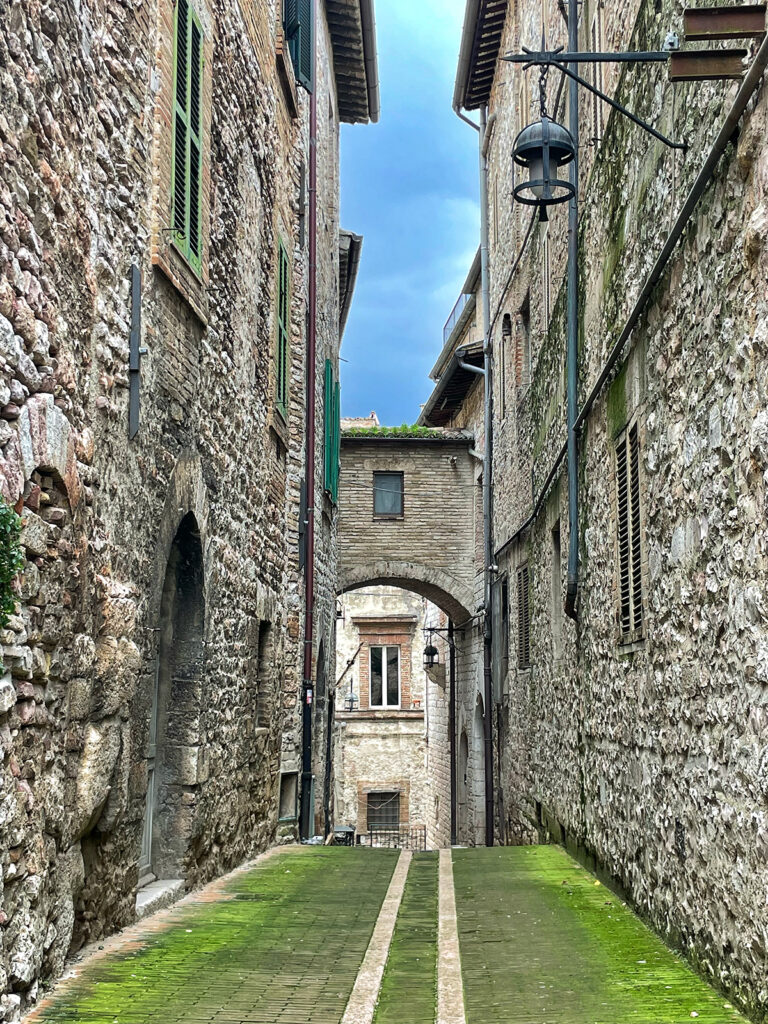
The area around Porta Perlici Street (via Porta Perlici) has some of the best streets and alleyways for exploring Assisi’s medieval urban architecture. The most atmospheric streets are the back alleys, called vicolos. Depending on how much time you have, you might like to take a slow meander through this quarter of the town, walking through several gates and down adorable side alleys.
This area is particularly good for potted plant displays. Even in winter, these streets are almost Cordoba-like. In summer, the blooming plants must be absolutely spectacular.
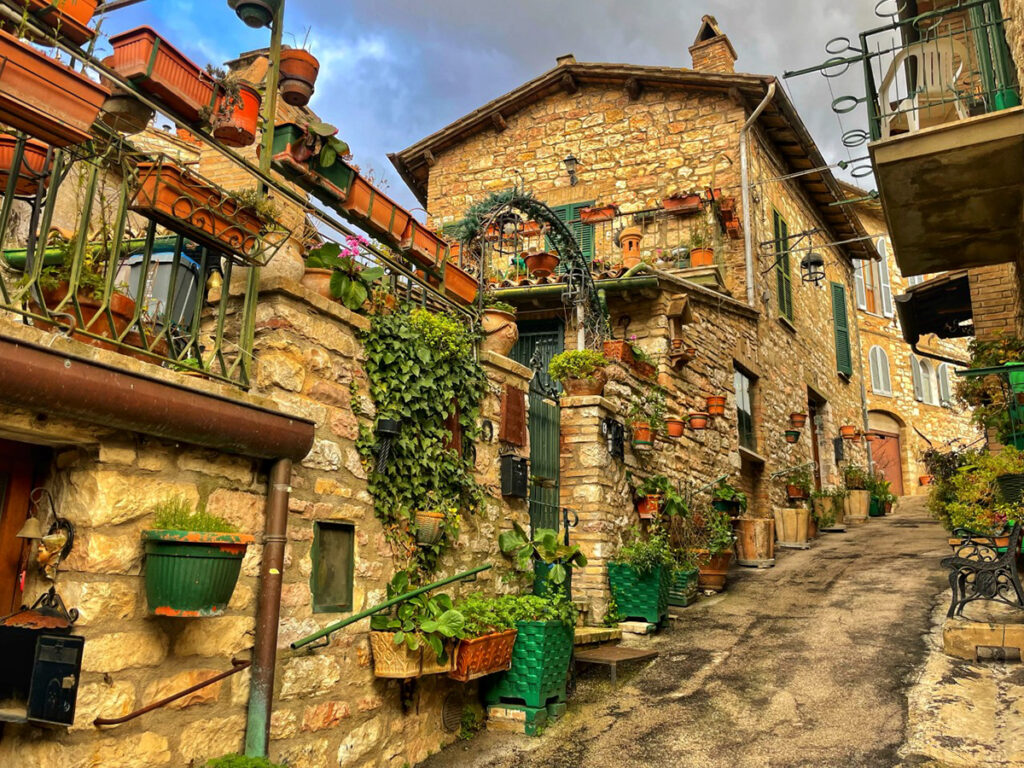
Another perk of starting your explorations from Porta Perlici is that you’ll be walking mostly downhill. Sitting on the side of a mountain, Assisi has some pretty steep streets.
Assisi Cathedral – La Cattedrale di San Rufino
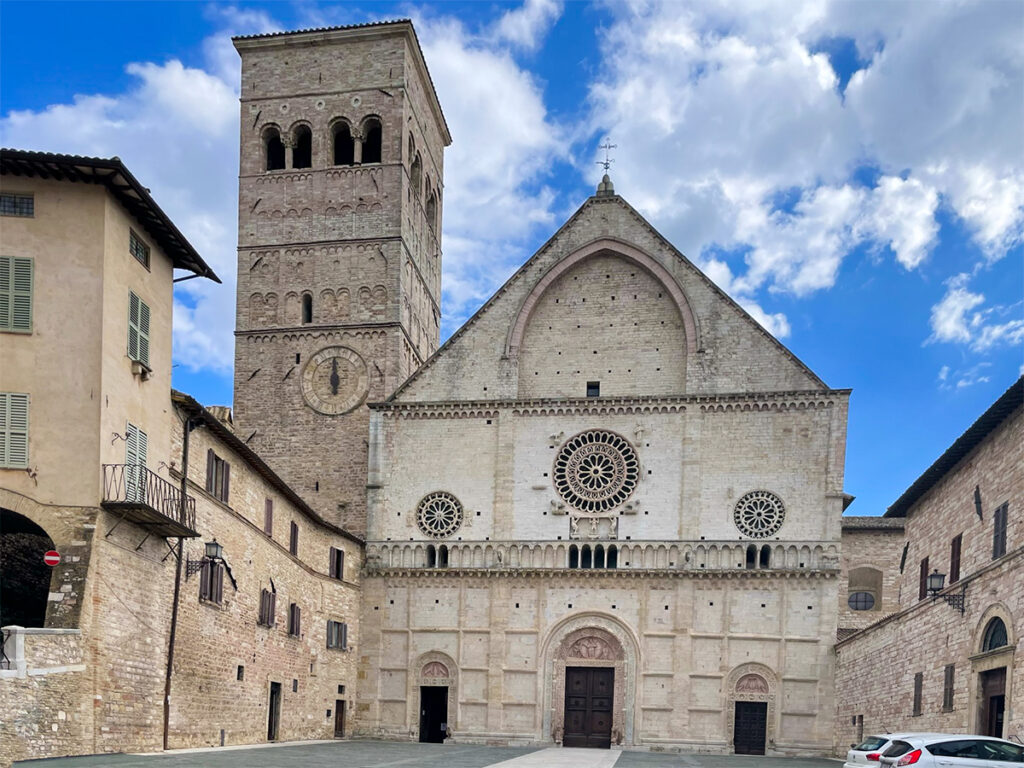
The first basilica you come to is the Assisi Cathedral – the Basilica di San Rufino. Built in the 11th century on top of an earlier church, that was built on top of the Roman cistern, San Rufino has one of the best and purest Romanesque facades in all of Italy.
If you are used to the Renaissance churches in Italy, you’ll find the interior decorations of the Cathedral quite modest. There is a crypt that contains the remains of bishop Rufinus of Assisi who was Assisi’s holiest man before Saint Francis.
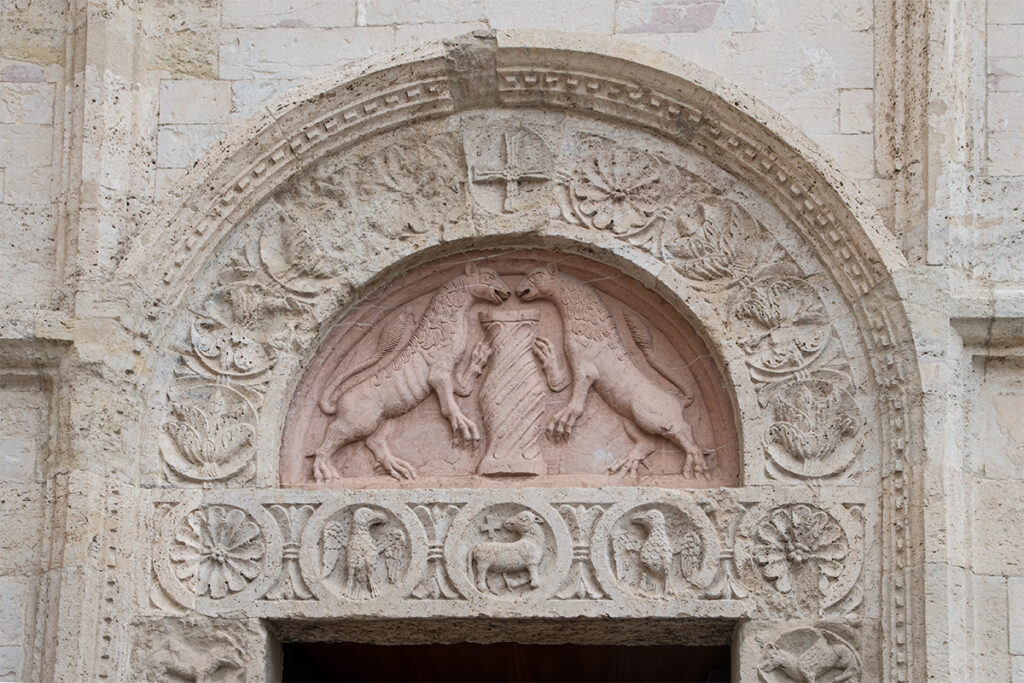
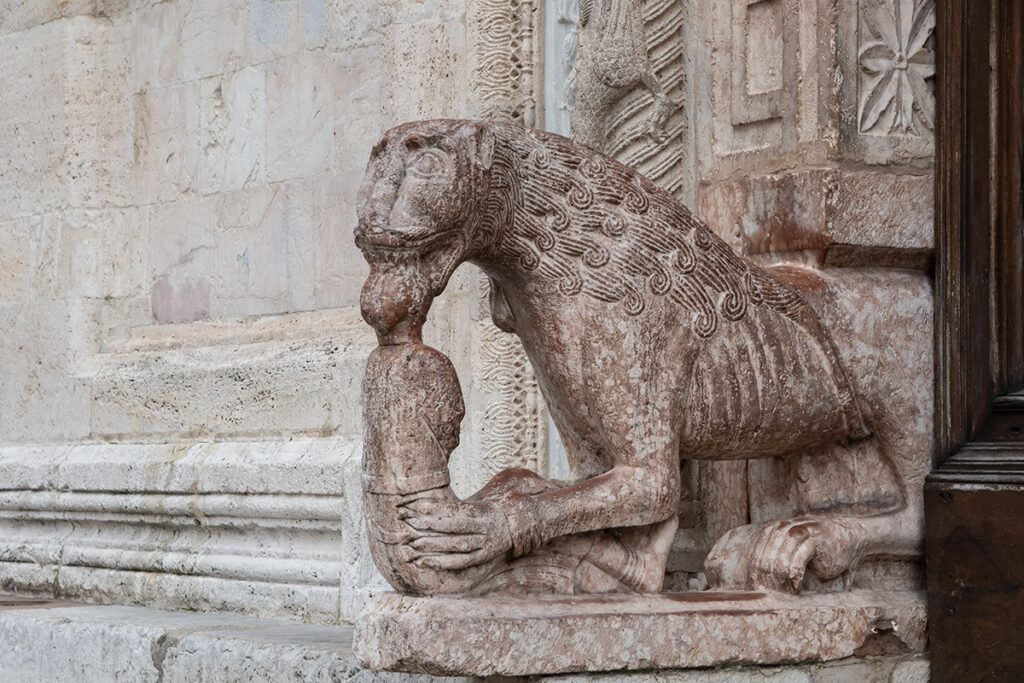
Between April and September, you can climb the cathedral’s bell tower to see the sweeping views of the town. But the most interesting part of the cathedral is located below it.
Artfully preserved as The Cathedral Underground museum, the extensive vaulted basement of San Rufino is a church underneath a church that displays artworks from the earlier churches that stood on this spot and the remnants of the Roman Forum with fantastic images reconstructing what this area looked like in Roman times.
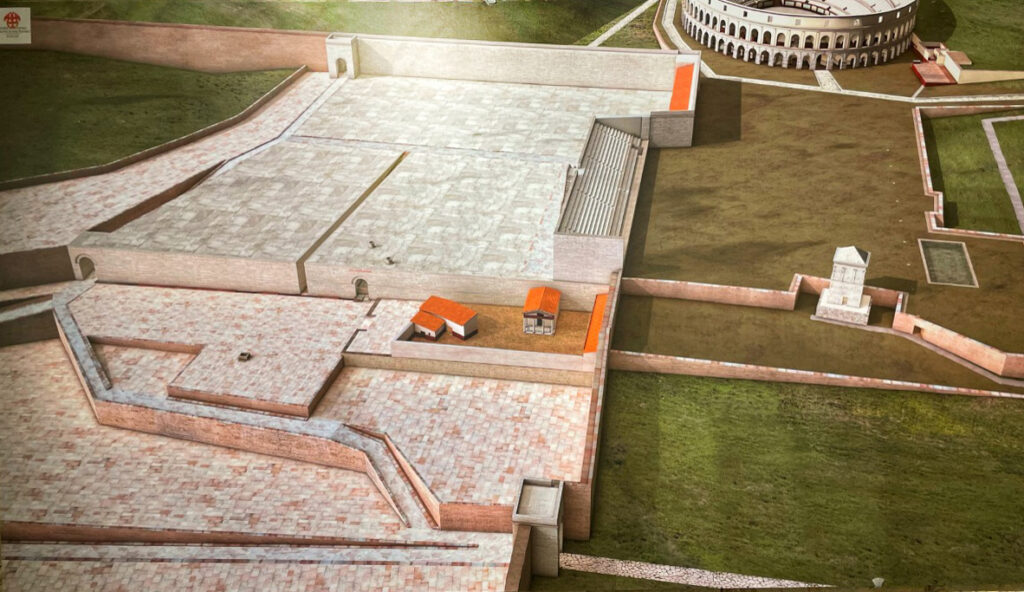
In front of San Rufino Cathedral, you can see a section of the original Roman pavement behind a metal railing. This was part of the main road that lead to the forum. Take this chance to stand on the 2,000-year-old pavement as you gaze at the 11th-century cathedral.
Adorable Medieval Streets
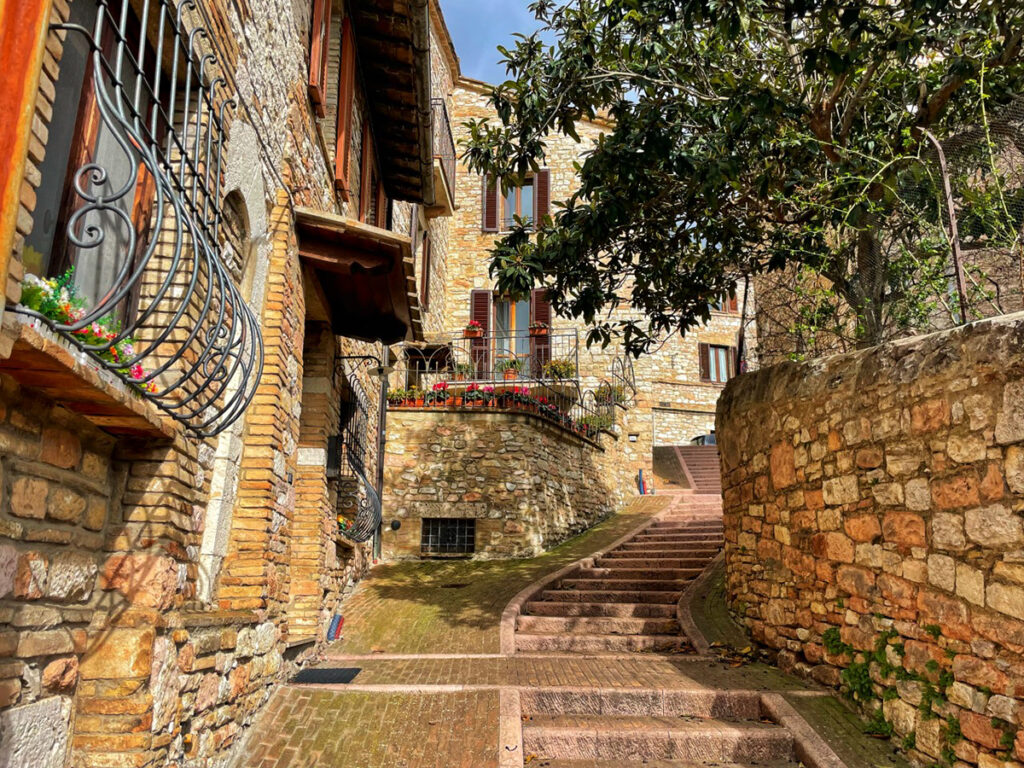
Before you leave the San Rufino area, take a stroll through some back streets here. Finding the charming gems of medieval back lanes was one of my favourite things to do in Assisi, so I’ll tell you where the best hidden alleys are.
With your back to San Rufino Cathedral, you’ll be looking down via S. Maria delle Rose. This street leads to some of the most adorably irregular alleyways in all of Assisi.
Walk along the street for a few meters until you reach Quo Vadis – an incredibly charming hotel with views over medieval rooftops from its rooms. This is where I stayed in Assisi, and you can read my review of Quo Vadis if you are looking for a gorgeous place to stay in town.
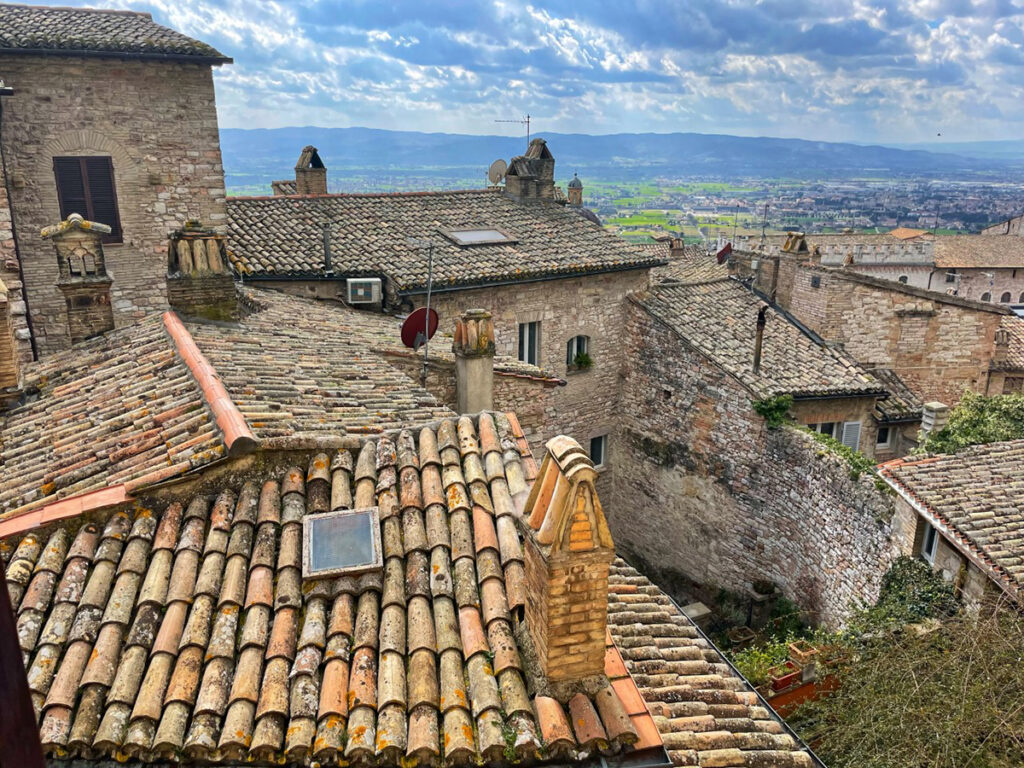
Just past Quo Vadis, there is a little lane – Vicolo della Forteza ducking downhill on your right. Follow this lane, then walk down vicolo S. Agata until you come to the meeting point of three different alleyways with a house standing at the convergence of these alleys, some of which run uphill and others downhill from this point. It’s the most tangled-up arrangement of streets in town.
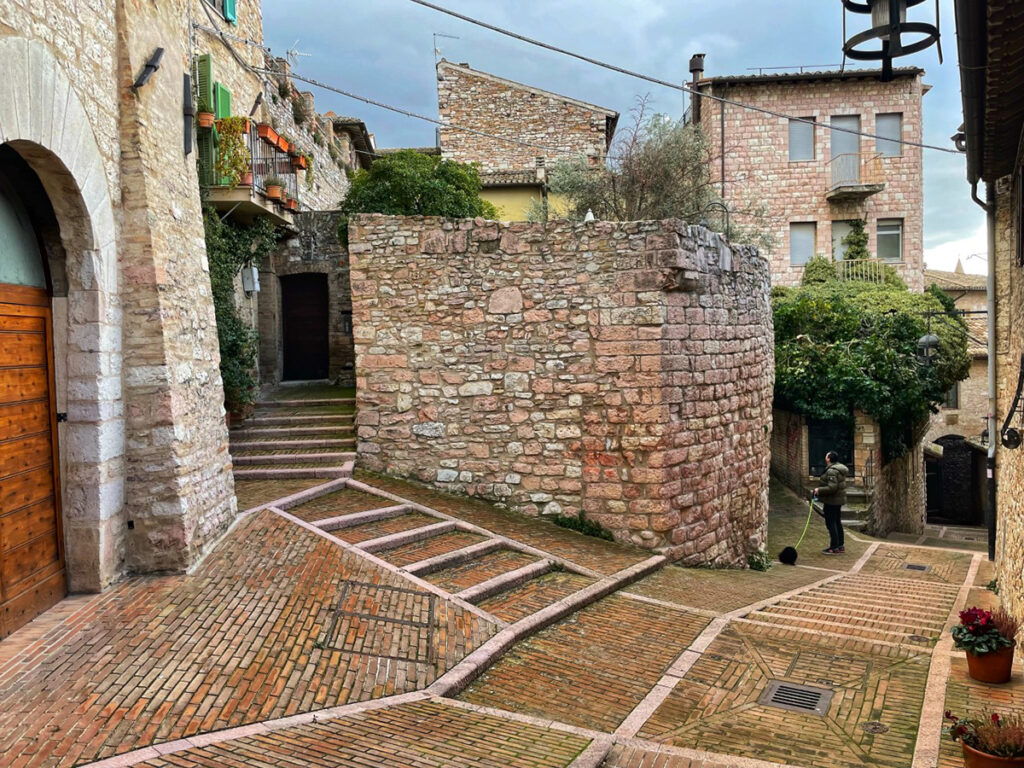
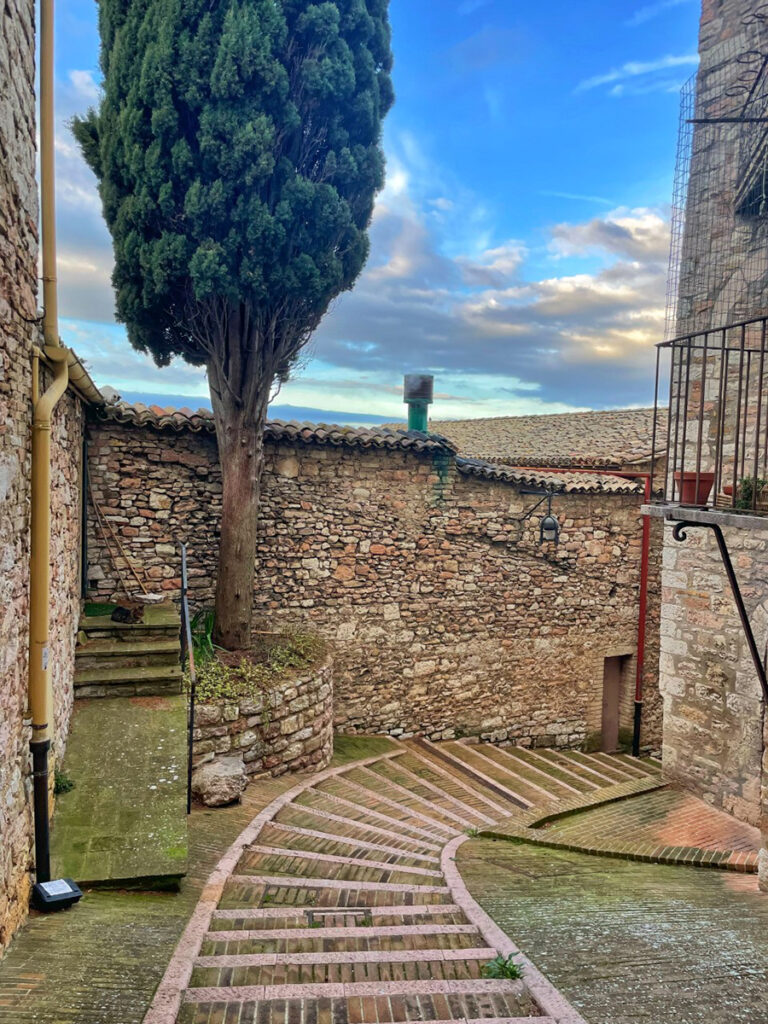
Next duck through the arch onto vicolo del Cipresso. Here a very hardy cypress tree is growing among the walls and pavement of the street. It is amazing that the tree is able to survive and flourish, by the looks of it, in such a uniformly paved environment. Its roots must run very deep.
Back at Piazza San Rufino, there is a local favourite pizza shop – Pizzeria da Andrea. They sell pizza by the slice that you can either eat in the shop or get it to-go. All their pizzas are superb, but anything with truffles is divine.
Once you are ready to continue, follow the signs on the corner of Andrea’s pizzeria for Santa Chiara. You can find street signs pointing to various points of interest in Assisi on virtually every street corner. It is a very easy town to navigate.
Church of St Clare – Basilica di Santa Chiara
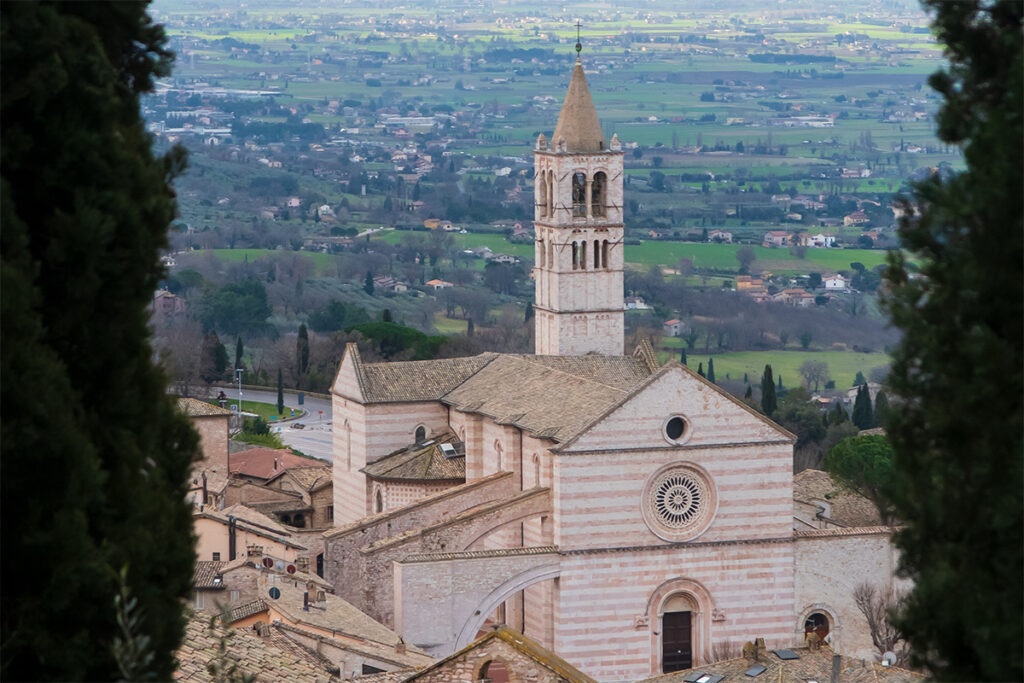
St Clare was Assisi’s much-beloved daughter. Born into a wealthy family, Clare fell in love with St Francis’ teaching. So much so that she ran away from her father’s house and came to live in voluntary poverty in a humble church just outside the town walls – San Damiano.
Soon other women joined her and the Order of Poor Clares was born. The poor Clares always remind me of St Teresa and the Barefoot Carmelites of Avila in Spain. Taking on a life of poverty seemed to appeal to some medieval ladies.
Clare lived such a simple life of virtue and obedience at San Damiano that she was canonized as soon as she died in 1253. And only 12 years later, the Basilica di Santa Chiara was built, where the Poor Clares still stay at the convent today.
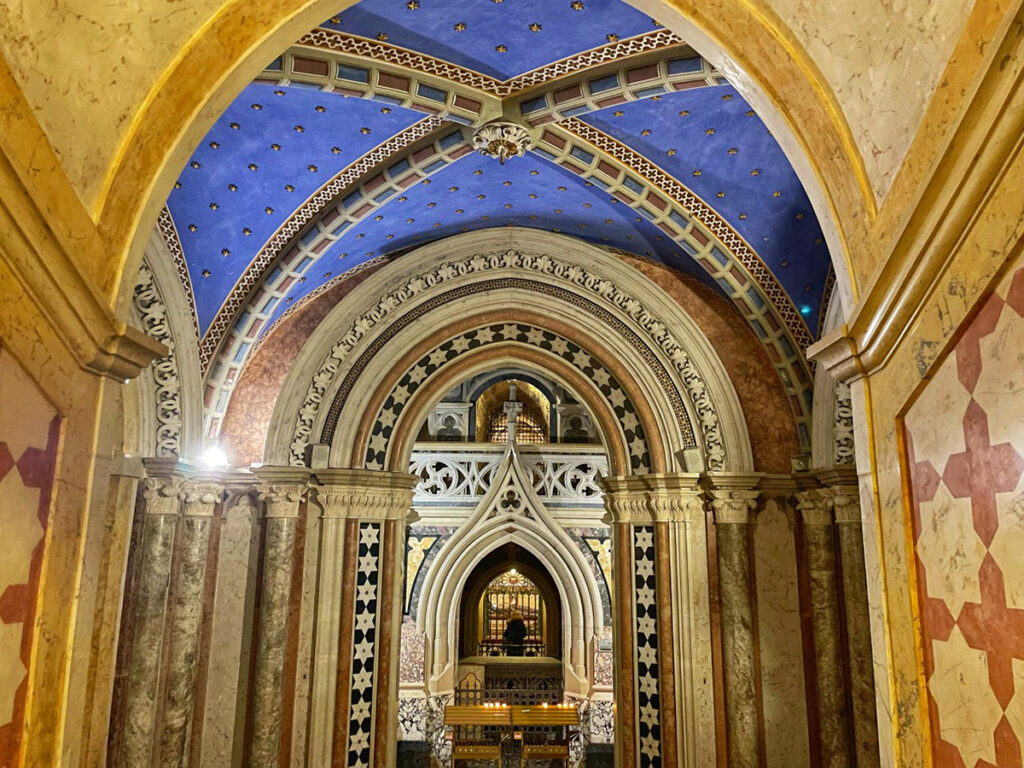
There are some beautiful frescos in the church, but most of them were covered with whitewash in later centuries. The ridiculous custom of covering frescos with whitewash has concealed a phenomenal amount of art all across Europe, even as far as Constantinople.
The crypt of the church contains St Clare’s tomb. And in the chapel of the Crucifix of San Damiano – you can see the cross that ‘spoke’ to Saint Francis (in answer to his prayers) instructing him to rebuild the church.
Via Santa Chiara
Running between Porta Nuova and the church of St Clare, Saint Clare Street is an interesting stroll. The street is quite short, but it has fantastic views of the valley and some of the best artisan shops in town. It also gives you a sense of how Assisi grew over the centuries.
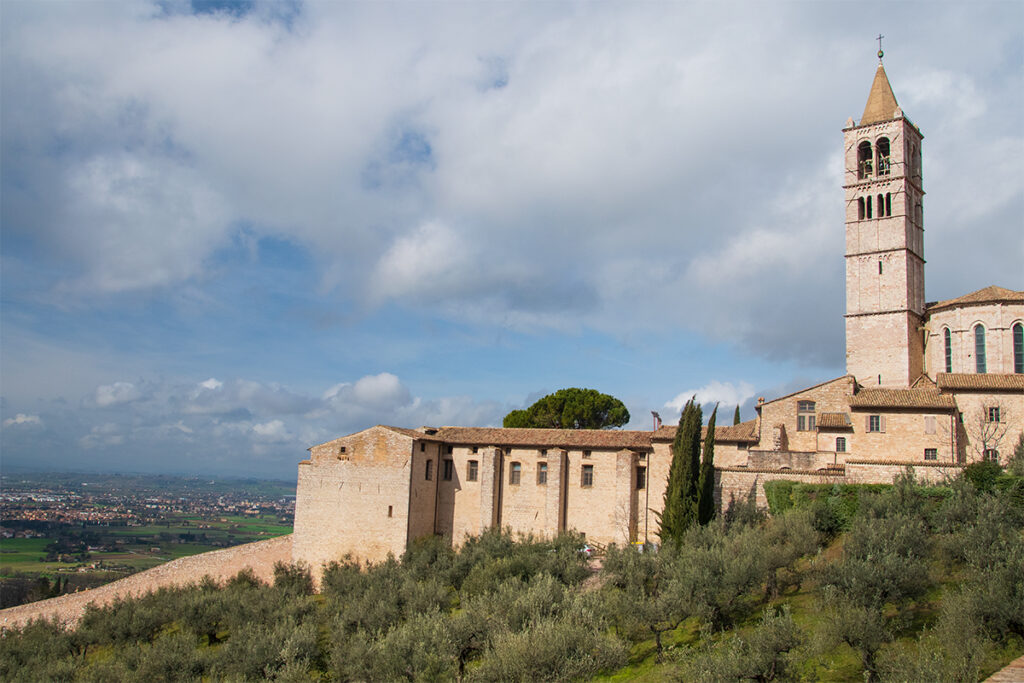
You can see three different city gates here. Looking towards the centre of town, there is a Roman gate – this is where the Roman city wall ran. Just behind the church is a medieval gate that marks the course of the medieval city wall which you can see running down the hillside along the back wall of the church. And further up the street is the grand Puerta Nuova (the New Gate) that marks the second medieval extension of the city walls in 1316.
If you are looking to take home some high-quality home decor souvenirs, Daca shop, a short stroll outside the city wall through Porta Nuova has some divine merchandise. It’s not cheap, but it’s the best quality homewares you’ll find in Assisi.
From St Clare church, head uphill following signs for Piazza del Comune – the heart of Assisi
Piazza del Comune
Piazza del Comune has been the centre of Assisi for 2,000 years. There are a few things to see here. It is also a good place to stop for lunch – there are several bars and restaurants in the square.
Temple of Minerva
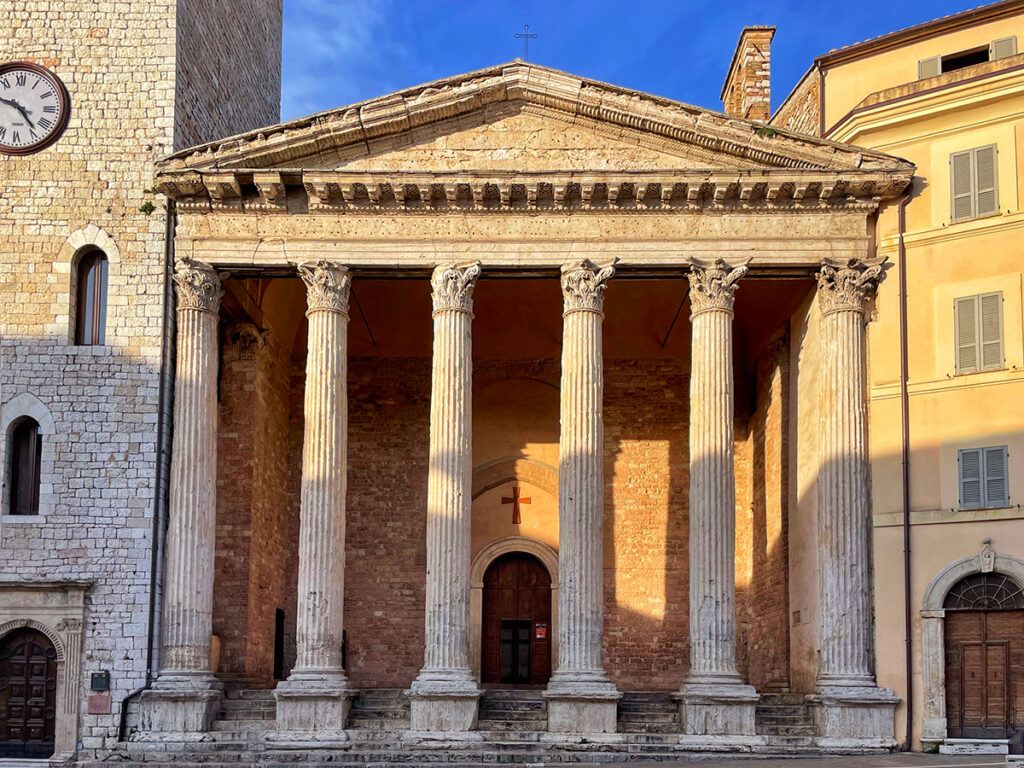
Piazza del Comune is dominated by the spectacular colonnade that used to be the front of the Roman Temple of Minerva built in the 1st century BC. It is considered to be the best-preserved Roman temple facade in Italy.
The reason the temple is so well-preserved is that it was converted to a church in 1539. Visit the church and you will see original Roman flooring on both sides of the altar. There are even ornate stone drains on the floor, supposedly for the blood from sacrifices to flow to.
Torro del Popolo
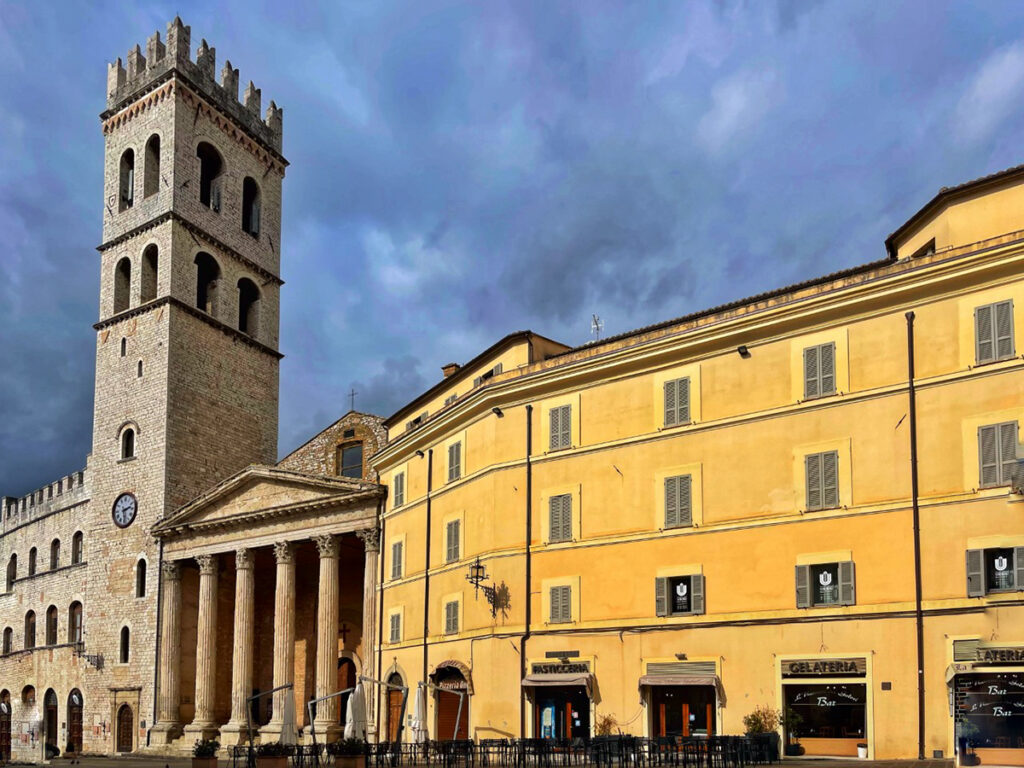
Adjacent to the temple is the 47-meter-tall Popolo Tower. You can climb the tower for 5 euros on Fridays, Saturdays, and Sundays (the tickets are sold at the Tourist office at the plaza). Unfortunately, the protective wire mesh at the top makes photography all but impossible. Unless you use your phone camera and position it between the wires
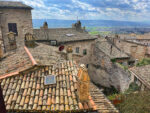
The view is quite good. It sweeps over the cloud-shrouded Monte Subasio, the green fields of the Valley of Tescio that stretch out to the horizon, and the medieval rooftops of Assisi’s streets. To find more epic views in Assisi, read my guide to the 12 Assisi Streets with the Best Medieval Architecture and Superb Views.
Painted Archway
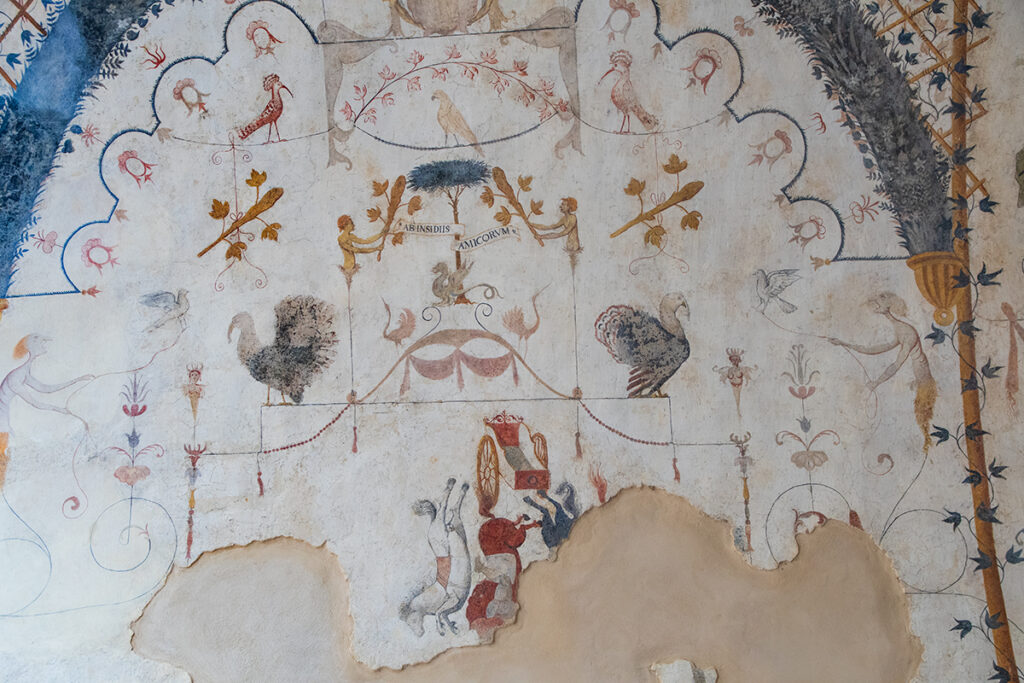
Right across from the temple, there is a 16th-century archway that used to be part of the town’s market. The ceiling of the vault is decorated in a style that became popular during the Renaissance, called the grotesque style. The name doesn’t sound very appealing but trust me, it’s gorgeous.
The term ‘grotesque’ comes from the word ‘grotto’ or ‘cave’. This style was discovered by Renaissance artists, including Rafael (an Umbrian native) who made their way into the subterranean Nero’s palace in Rome.
Because Nero was a very controversial figure in his day, after his death Romans wanted to destroy all traces of his presence. They even built the Colosseum on the site of Nero’s golden palace. The rest of the palace was filled with earth and public baths were built on top of it.
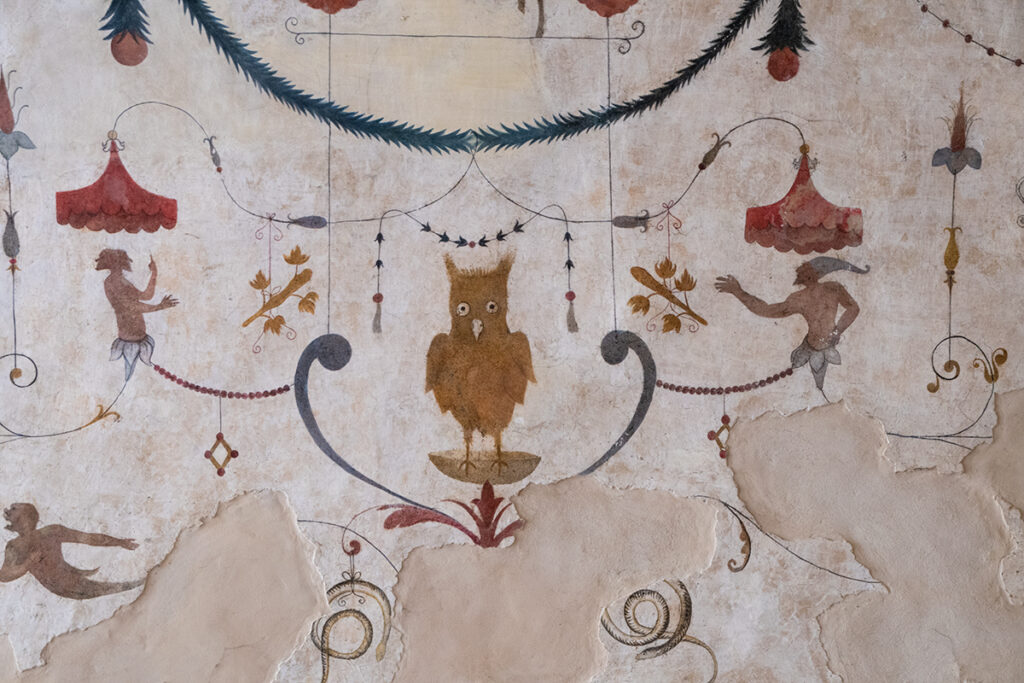
So when the Renaissance artists were exploring Roman ruins in search of classical art, they made their way into a hole in the ground and found themselves in Nero’s stunning palace half-filled with earth. And this is where they saw this style of painting. So they called it grotto-esque because, as far as they were concerned, they were in a painted cave.
This style of painting has been used in the most spectacular way by Vasari in decorations of Medici’s Palazzo Vecchio in Florence. You can also see it on the walls and ceiling of the Vatican Museums in Rome. So this archway is a very special piece of Renaissance art in Assisi.
Libreria Tipografia Zubboli
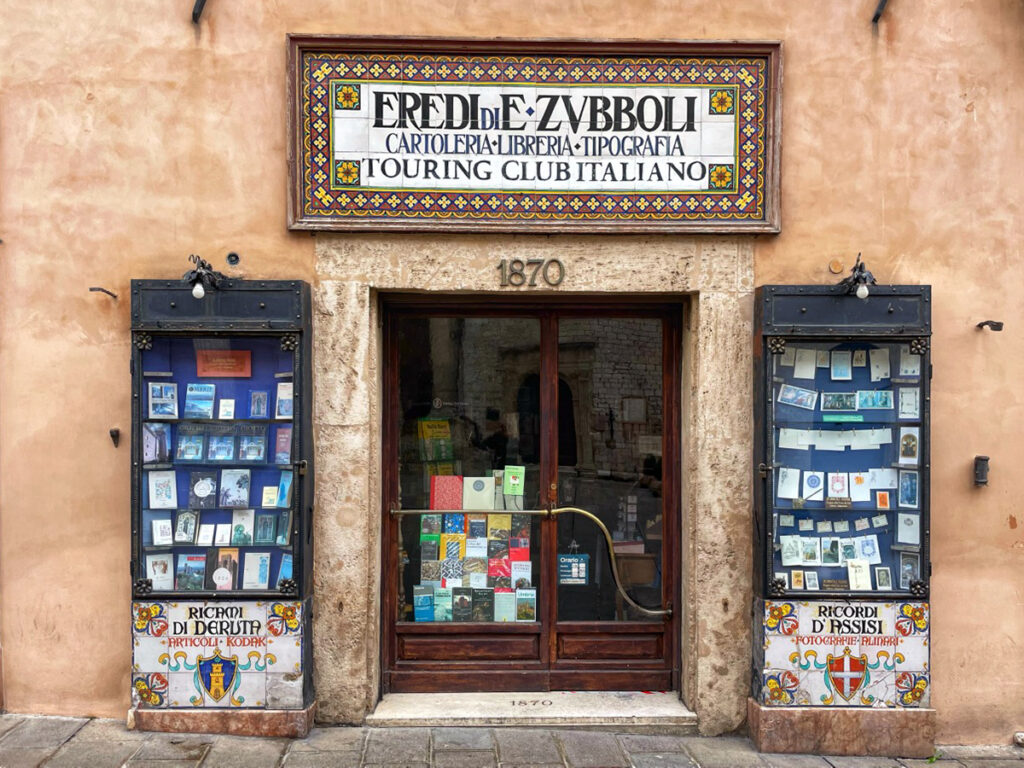
Also on Piazza del Comune is one of Assisi’s oldest and most unique shops – Libreria Tipografia Zubboli bookshop (Piazza del Comune, 18). They specialize in exquisite hand-made marbled paper notebooks, leather-bound hand-made cotton paper notebooks, as well as history books and travel guides. It is a beautiful shop that has been passed down in the family since 1870.
Roman Forum and Archaeological Museum
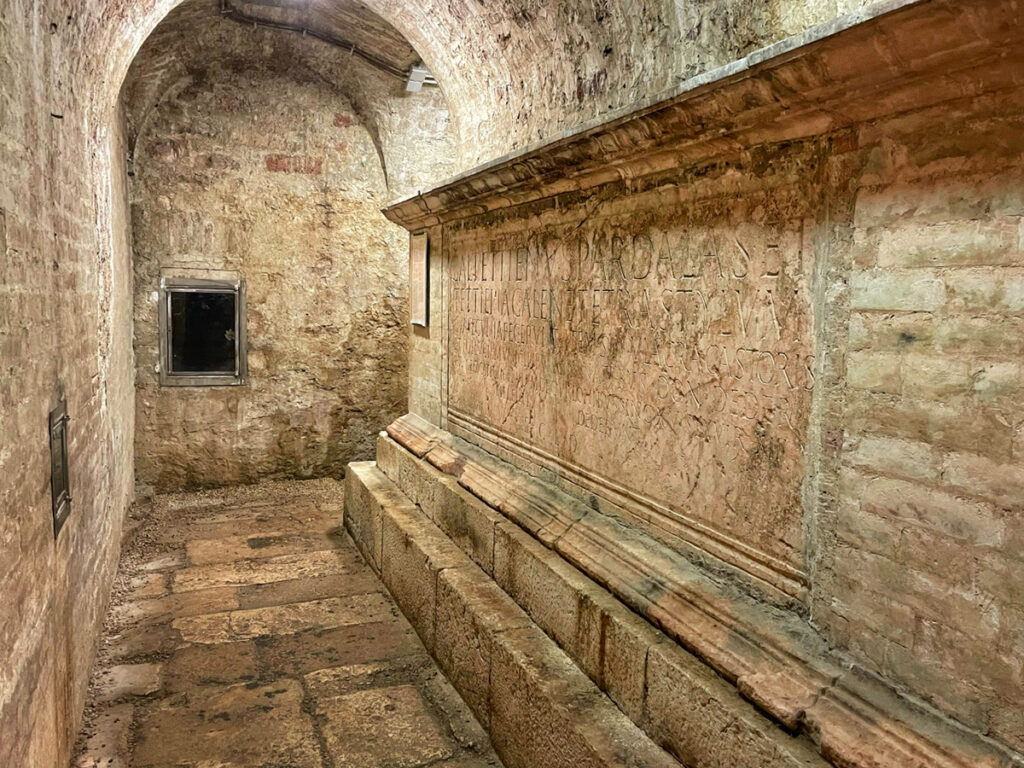
If you wanted to get an idea of what Piazza del Comune looked like in Roman times when it was the town’s main forum, head underground to the Roman Forum and Archaeological Museum. The entrance is via Via Portica.
It is a fascinating space. The video in the museum shows the reconstruction of the forum, including the Temple of Minerva, two large statues in front of it and the market stalls around the perimeter.
The base on which the statues stood is right there in the museum, in the same spot it always stood. There is also a model of the forum on display. It’s a fascinating museum for Roman culture buffs.
Chiesa Nuova – New Church
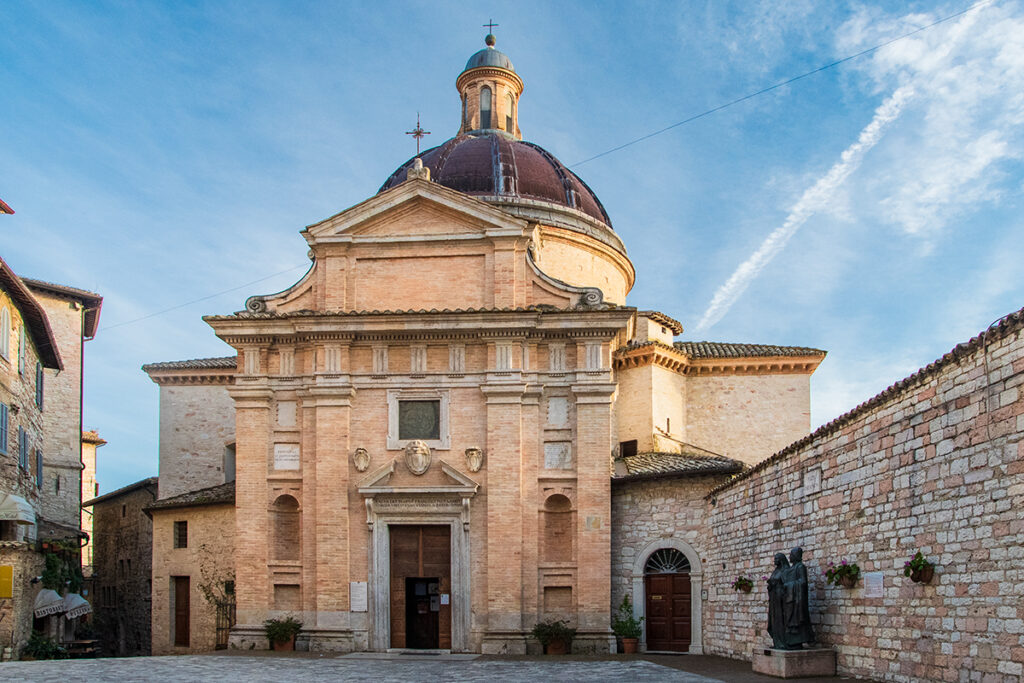
Just a 1-minute stroll from Piazza del Comune into the maze of back streets is the Chiesa Nuova – New Church with a beautiful exterior and some lovely frescos inside.
It was built in 1615 on the site of the presumed birthplace of St. Francis, and because it was the last church to be built in Assisi at the time it was called the New Church.
Unlike all other churches in Assisi, Chiesa Nuova is built in the late Renaissance style, inspired by Sant’Eligio degli Orefici church in Rome that was built and designed by Rafael. Together with the painted archway nearby, the church adds a lovely Renaissance touch to the medieval ambience of Assisi.
Fontebella Street – Best Views in Assisi
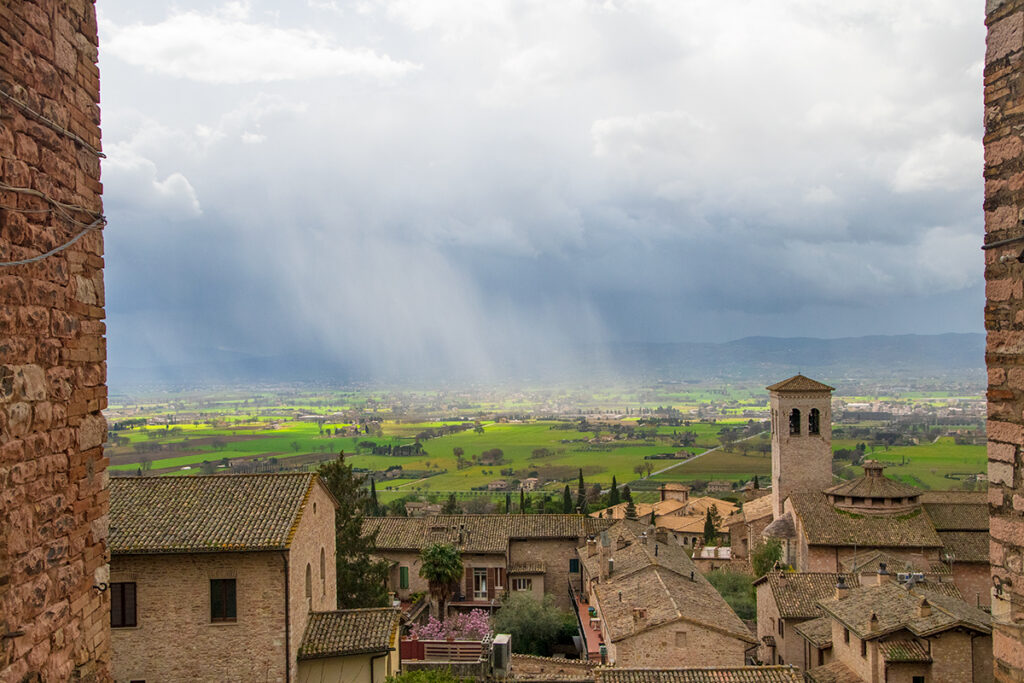
When you are ready to leave Piazza del Comune start heading towards the Basilica of St Francis. Two of the most beautiful streets in town lead to the basilica: via Fontebella and via San Francesco. So take via Fontebella on the way there and return by via San Francesco, with a little detour.
Via Fontebella has some of the best views in Assisi. About halfway along the street, there is a gorgeous viewpoint over the rooftops and the green countryside below. The best view is from the metal terrace next to Hotel Giotto. While this is not the viewpoint marked on Google Maps, it is the most panoramic view on Fontebella Street – almost 180 degrees.
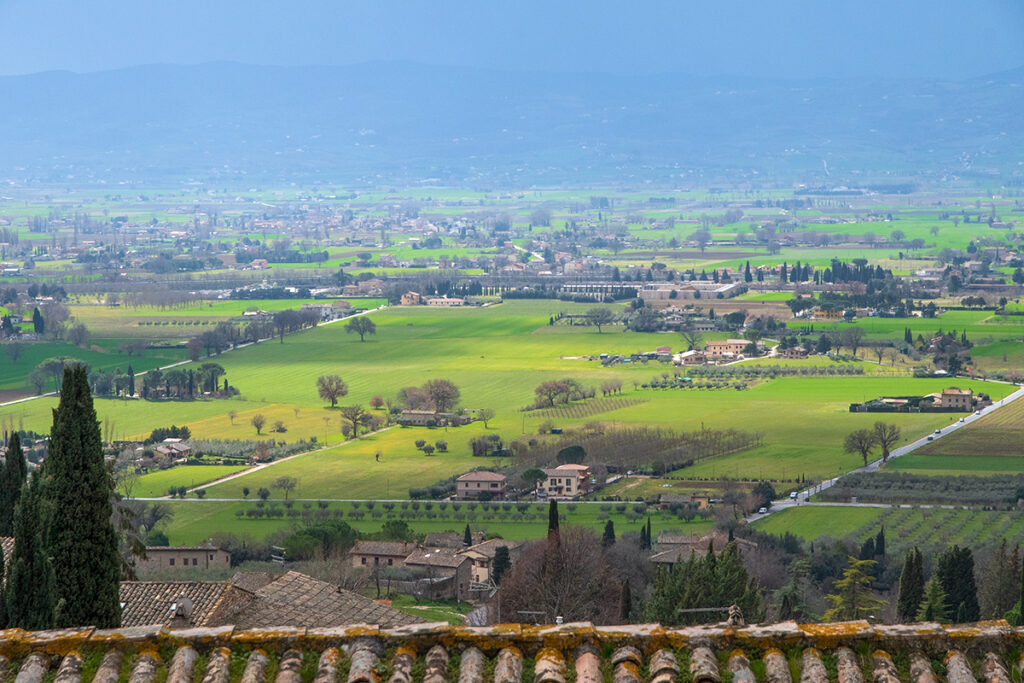
The view takes in the ornate rooftops of Chiesa di San Pietro (St Peter’s church) and the surrounding buildings and opens up to the brilliantly green fields of the valley below.
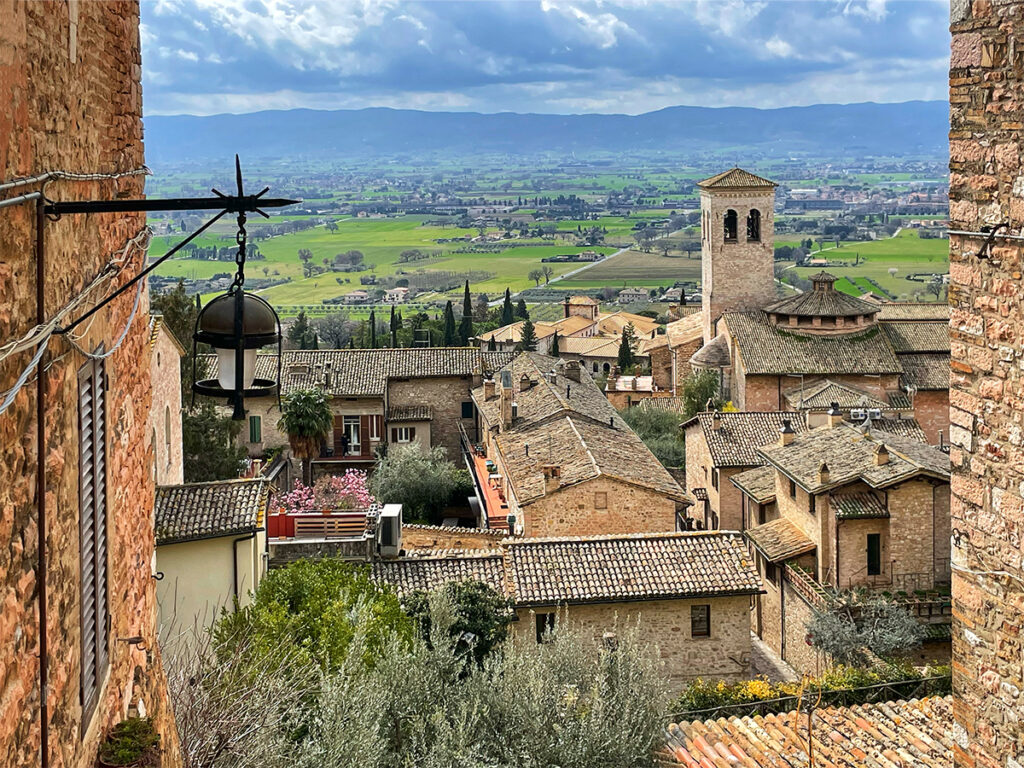
A few meters up the street, next to Fontebella Palace Hotel, there is another viewpoint – this one is framed by two buildings and a charming wrought iron street light hanging off one of the walls.
Another few meters up the street, there is a third viewpoint, marked as Panoramica on Google Maps (Via Fontebella, 15). And if you haven’t had enough of this particular view, walk up Vicolo Degli Esposti, past Bar Sensi and climb up a few stairs to get another view framed by the buildings.
If you are ready for an afternoon snack, Bar Sensi is a lovely patisserie that sells a wide range of traditional Assisi sweets. It is a great spot to enjoy the view with a cup of coffee.
Basilica of Saint Francis – Basilica di San Francesco d’Assisi
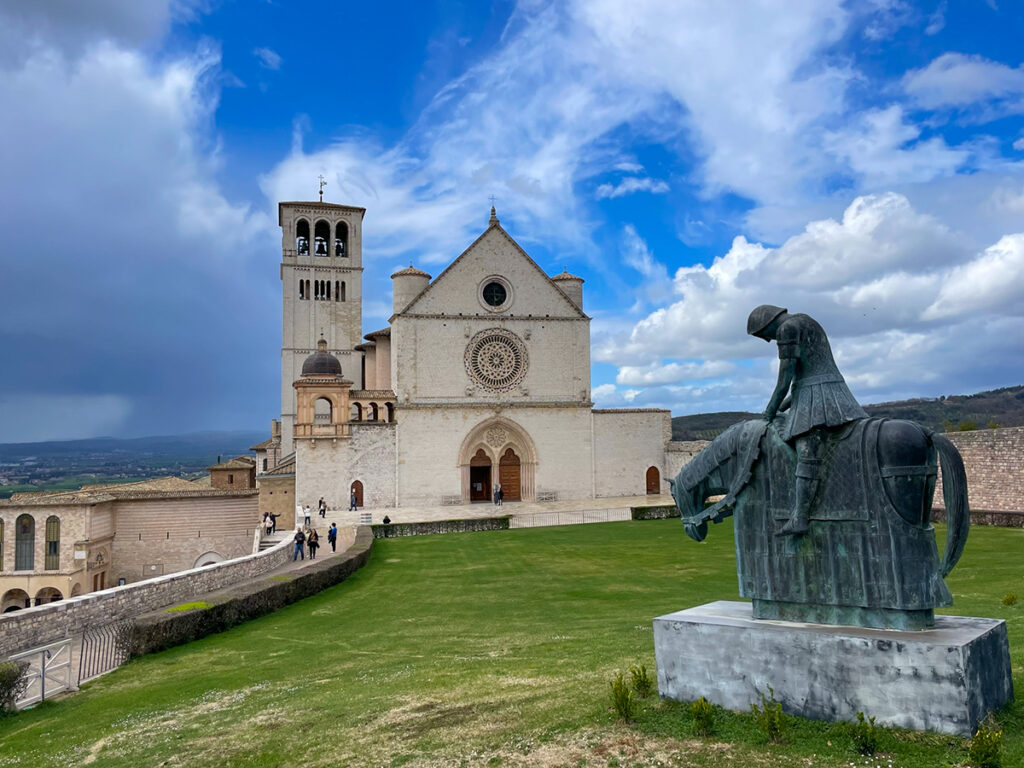
Giovanni di Pietro di Bernardone was born in 1181 into a rich family in Assisi. But after serving in the army during a war with Perugia, he became disillusioned with life and withdrew into prayer and meditation.
His life-changing revelation came during his retreat at San Damiano chapel after which he renounced his family and his name, becoming Francesco (or Francis) and choosing a life of voluntary poverty and service to god.
Francis’ message was that of simple life and unconditional love, not only for fellow human beings but for all of the natural world. Francis’ love for nature and animals would later make him the patron saint of ecology.
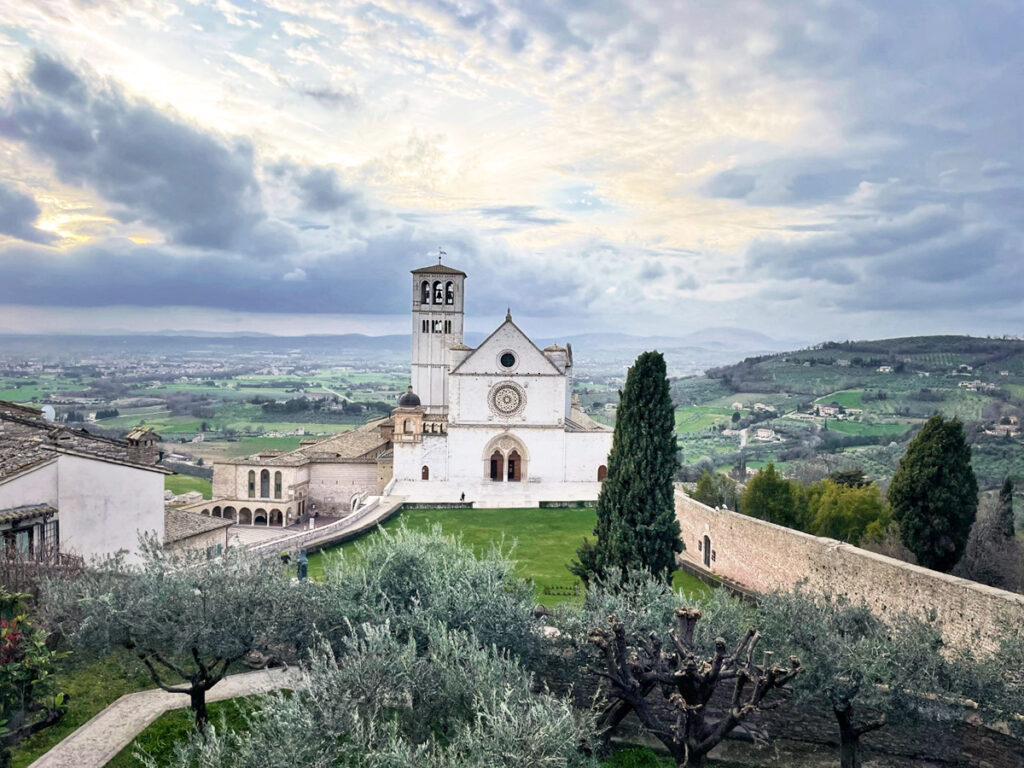
Before long, Francis acquired a large following and in 1210 the Franciscan Order was established. Today Franciscan churches can be found all over the world from Florence to Prague to the United States.
Francis died in 1226 and two years later he was declared a saint by the Pope. The following day, the Pope laid the foundation stone for the Basilica of St. Francis, where Francis was buried in 1230, under the Lower Basilica. And since then, pilgrims have been flocking to Assisi in their thousands.
St Francis church, the second most important church in Christianity after St Peter’s Cathedral in Rome, is actually two churches, the lower and the upper basilicas. The two are quite different in style, but both are exquisite. One historian named St Francis church as “the most beautiful house of prayer in the world”.
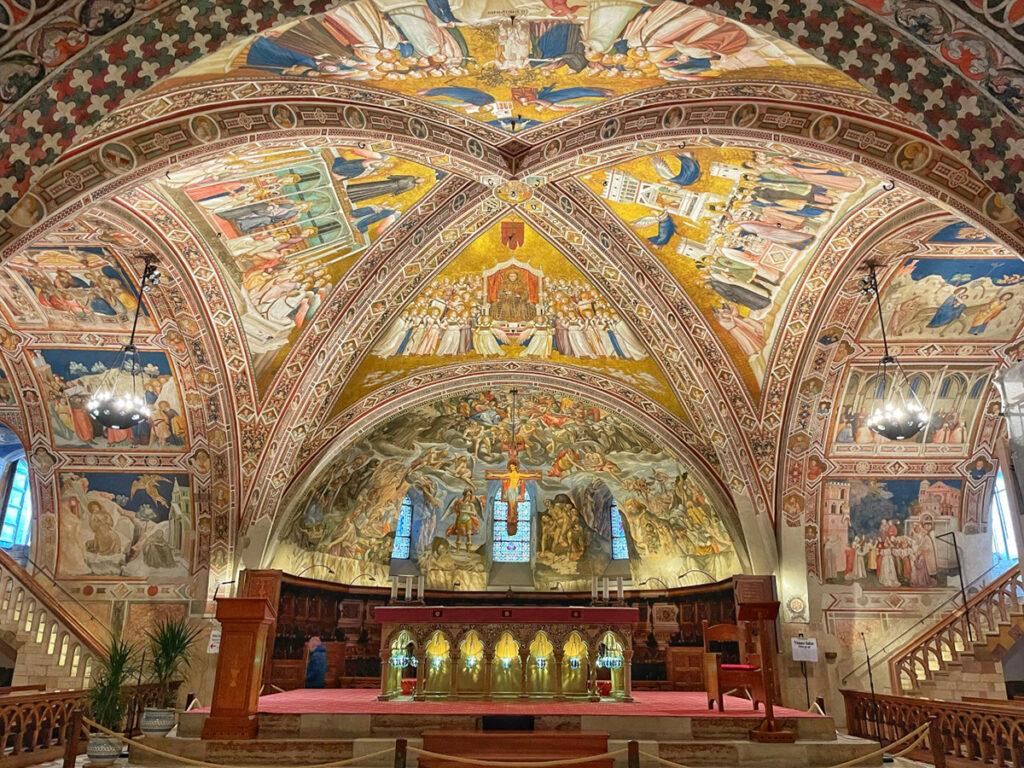
The lower basilica was built in the late Romanesque style with low vaulted ceilings and stunning frescoes by Giotto. The upper basilica has the same floor plan but with soaring gothic lines and stunning 28 frescos by Giotto and Simone Martini, that tell the story of St Francis. Completed in 1253, the upper basilica is the oldest Gothic church in Italy.
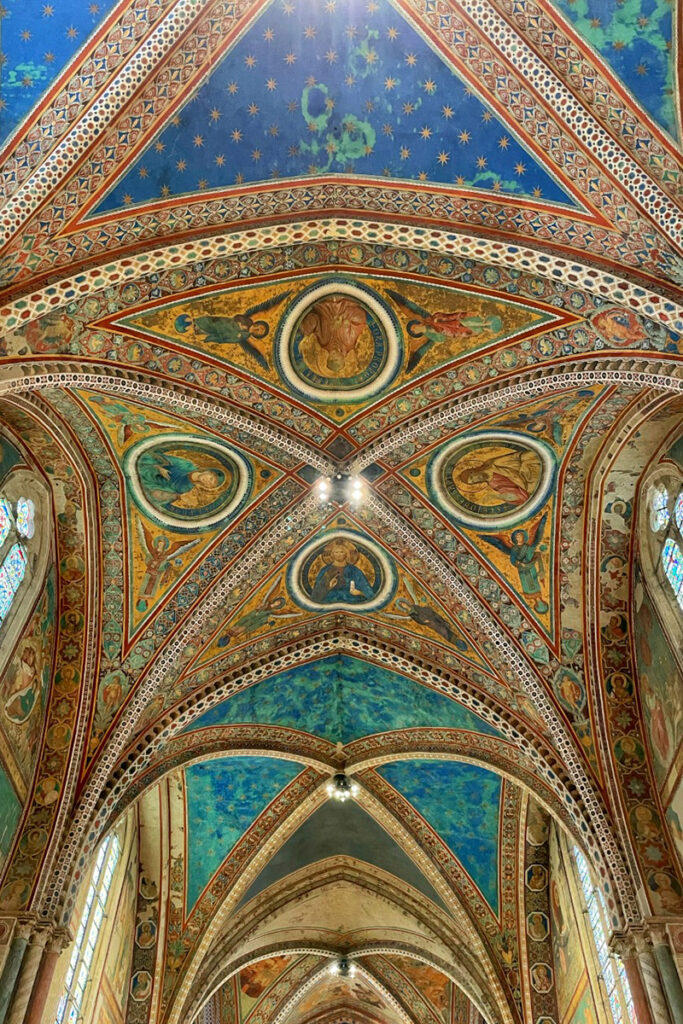
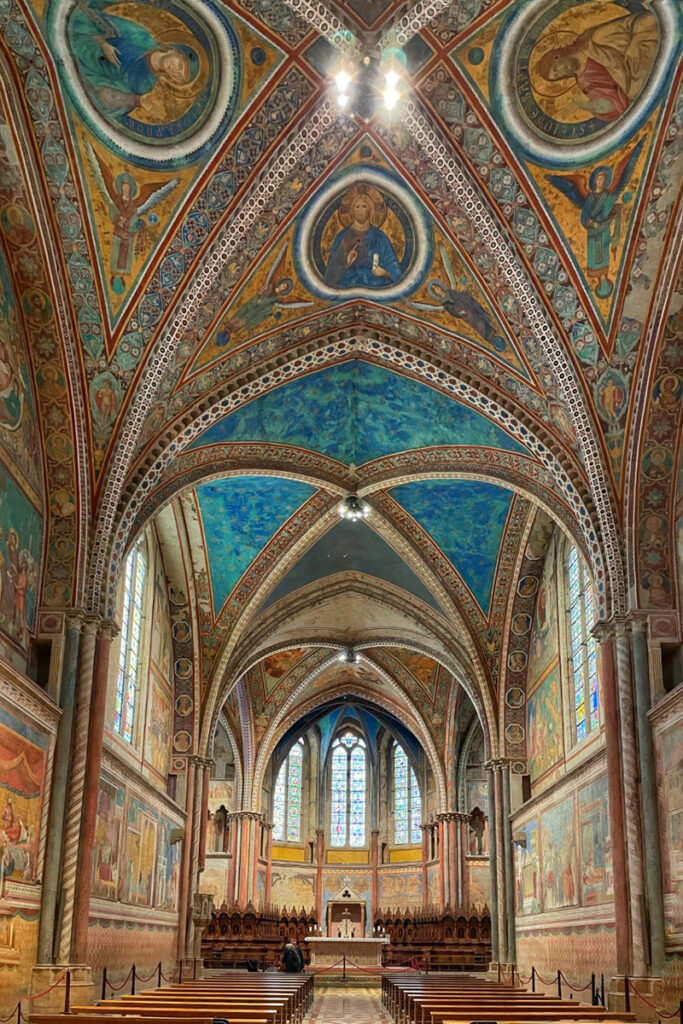
Foreshadowing the Renaissance that would come a century later, Giotto’s frescoes introduce three-dimensionality, emotion and context to the flat medieval art. Giotto enjoyed painting natural backgrounds to religious scenes, which made him the perfect artistic match for portraying St Francis’ love of nature and animals.
The overall effect of St Francis church is spellbinding. Its dazzling ceiling and vibrantly colourful frescoes create a mesmerizing effect, all the more unexpected for the austere Romanesque facade of the church.
As a rule, photography of any kind is not allowed in the church. I was simply lucky to be visiting in winter when there were few tourists and pilgrims in town, and during the time of some restoration work when art technicians were taking flash photographs of the frescoes to be restored.
I quietly snapped a couple of shots on my phone when no one else was around to avoid disturbing anyone seeking peace and quiet in the church.
Church of St Margherita Viewpoint
My favourite viewpoint in Assisi is the town’s most picturesque hidden gem. Looking for a nice vantage point to photograph St Francis Basilica I was wondering along the twisting vicolos that branch off from Via San Francesco.
Meandering without any particular purpose I followed a very picturesque Vicolo San Nicholas and came to a tiny square with magnificent views of the basilica and Umbrian countryside.
The square is so small, it’s not marked on Google Maps. It lies at the front of an unassuming 13th-century church of St Margherita – Chiesa Santa Margherita. And because it’s well concealed among the maze of back alleys, hardly anyone comes here.
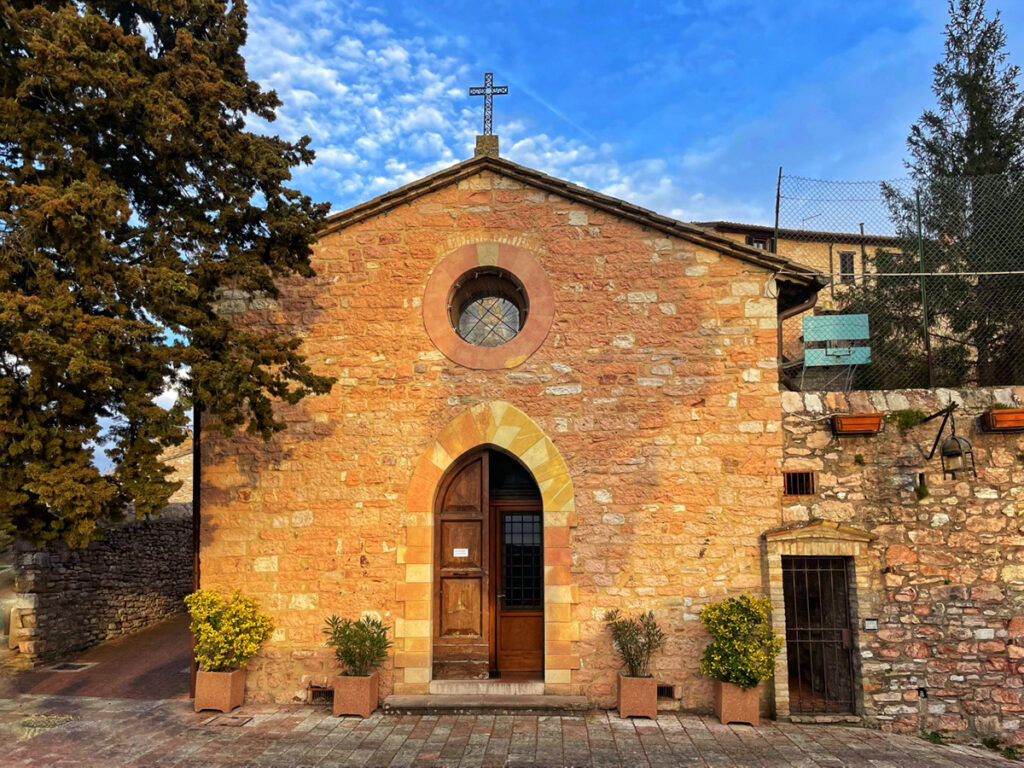
The easiest way to reach the square is via Vicolo Santa Margherita, just around the corner from Porta San Giacomo (San Giacomo Gate) – the one with the olive tree growing on top. Or follow Vicolo San Nicholas up the hill from via San Francesco. It’s only a short stroll through some of the best medieval architecture in town.
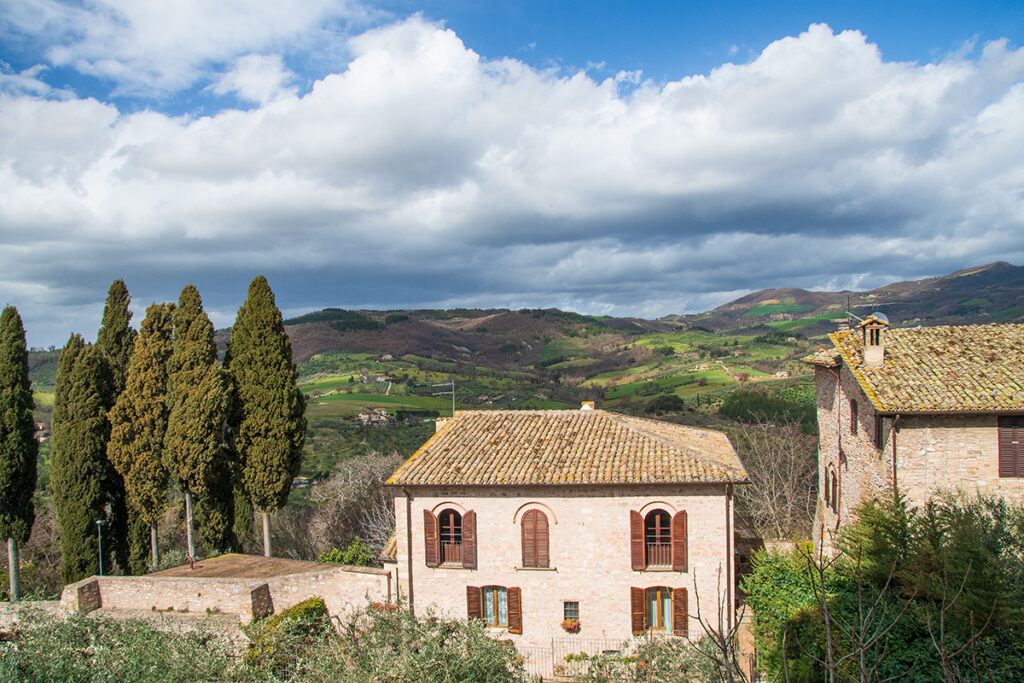
It is a serene little spot. There are two wooden benches at the square facing the panoramic view over the stone wall. If you come here for sunset, you’ll likely have the view and the square all to yourself.
Porta San Giacomo – Saint James Gate
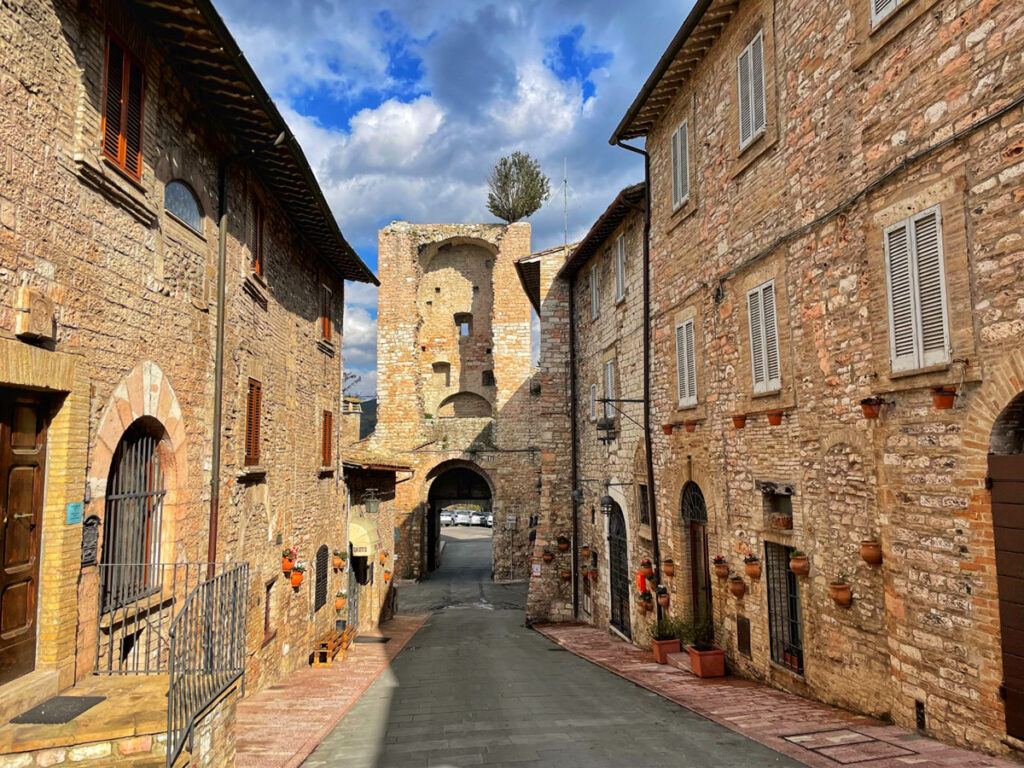
There are plenty of medieval city gates in Assisi, but only one of them has an olive tree growing on top of its tower – Porta San Giacomo. This stately 12th-century city gate was probably built on the site of an earlier gate.
Having walked through Porta Perlici at the start of your walk, you’ll be now exiting (even if only ceremoniously) through a gate at the opposite end of town. Even though there are plenty of sights to see and things to do in Assisi, the town is not very big at all.
Rocca Maggiore
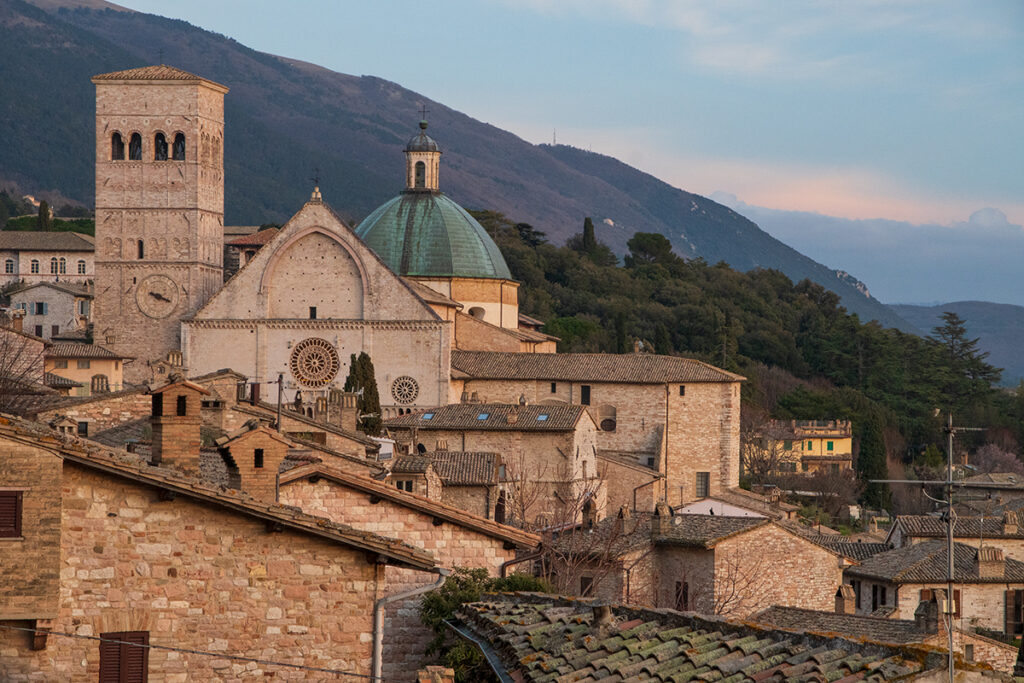
Towering over the streets of Assisi, Rocca Maggiore is a fortified castle that provided safety to the towns folk during troubled times.
There may have been a fort standing on top of the hill above the town since Roman times. At least, the smaller Rocca Minore on the neighbouring hill is confirmed to have Roman heritage.
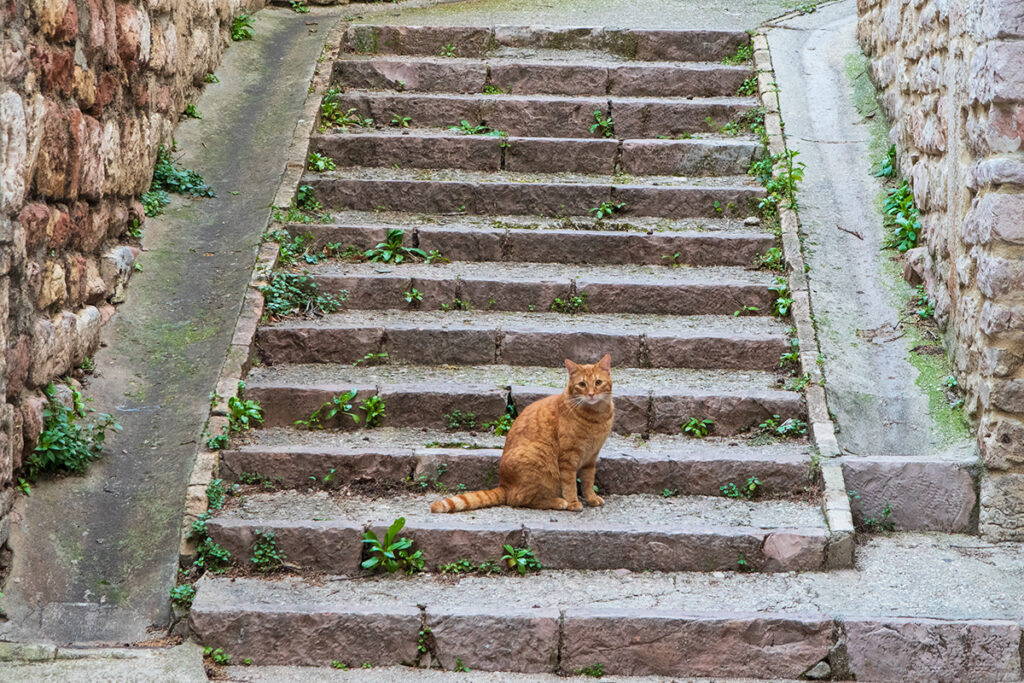
The current structure of Rocca Maggiore dates back to 1356, although the fort is much older. Unfortunately, it is currently closed for renovations, but don’t let this deter you from climbing the hill. It’s quite a short climb – 10-15 min from San Rufino Cathedral (via the steps on vicolo S. Lorenzo). And the views of Assisi from the fort are not something you’d want to miss, especially at sunset.
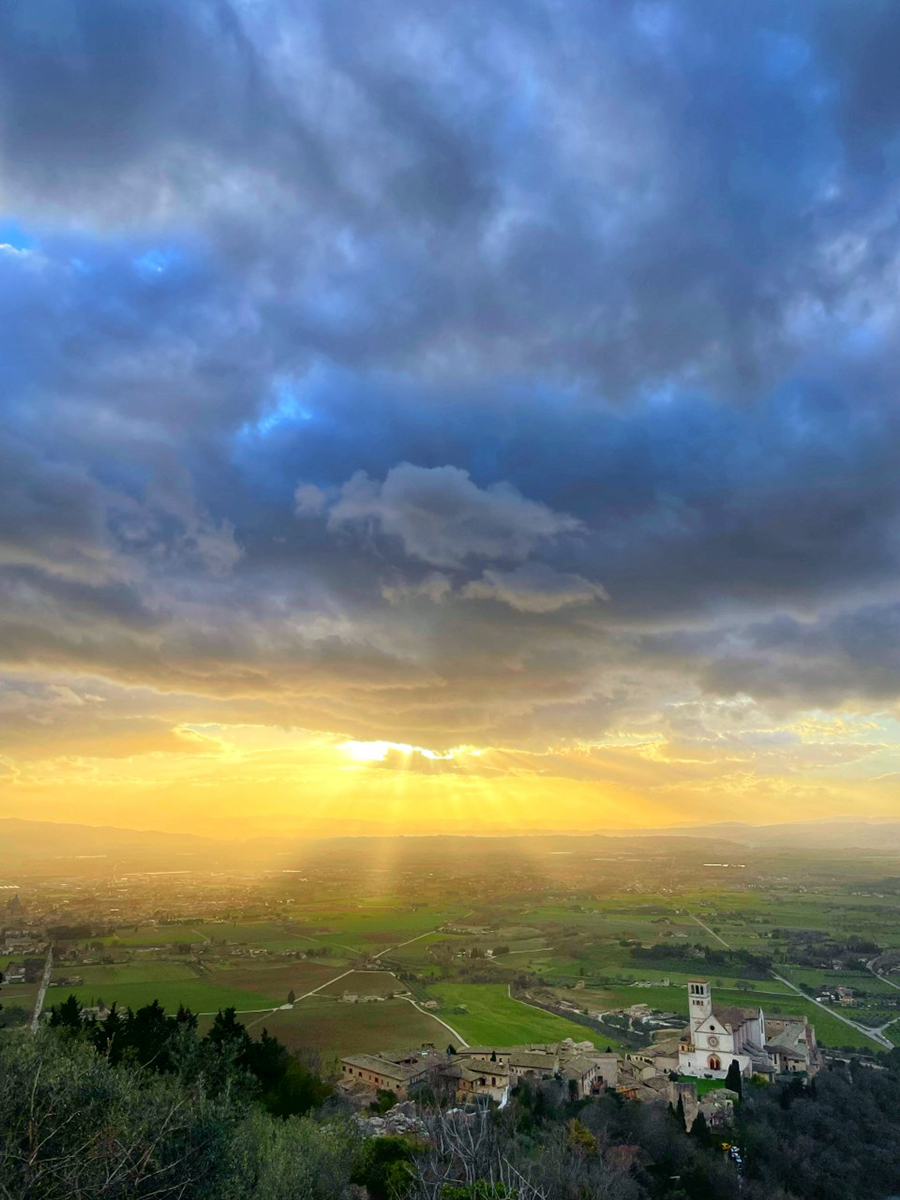
As you walk along the piazza in front of the fort, you’ll have good views of San Rufino, and Santa Chiara basilica, as well as of Rocca Minore. Walk to the very end of the ‘square’ towards the metal barrier and you’ll get a good view of San Francesco basilica.
San Damiano
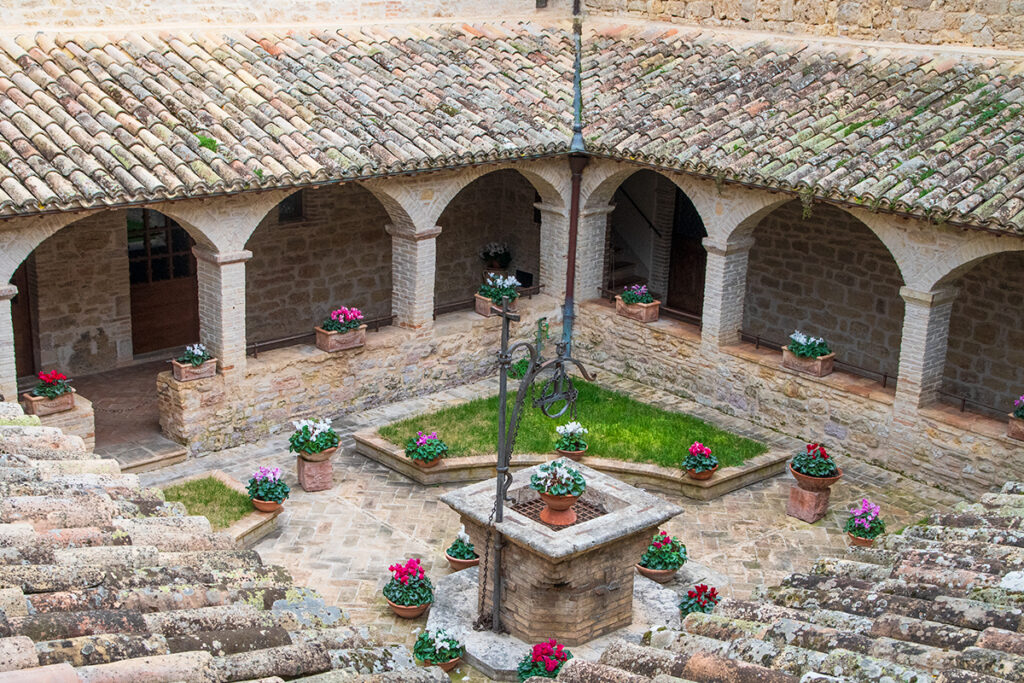
San Damiano is the quiet little church where Saint Francis received his life-changing message from god. Located just outside the city walls, it is exactly the kind of place you imagine when you think of an out-of-town medieval monastery – simple, peaceful, and quiet.
This is where St Clare came to live when she left her wealthy family in Assisi to follow St Francis’ teaching.
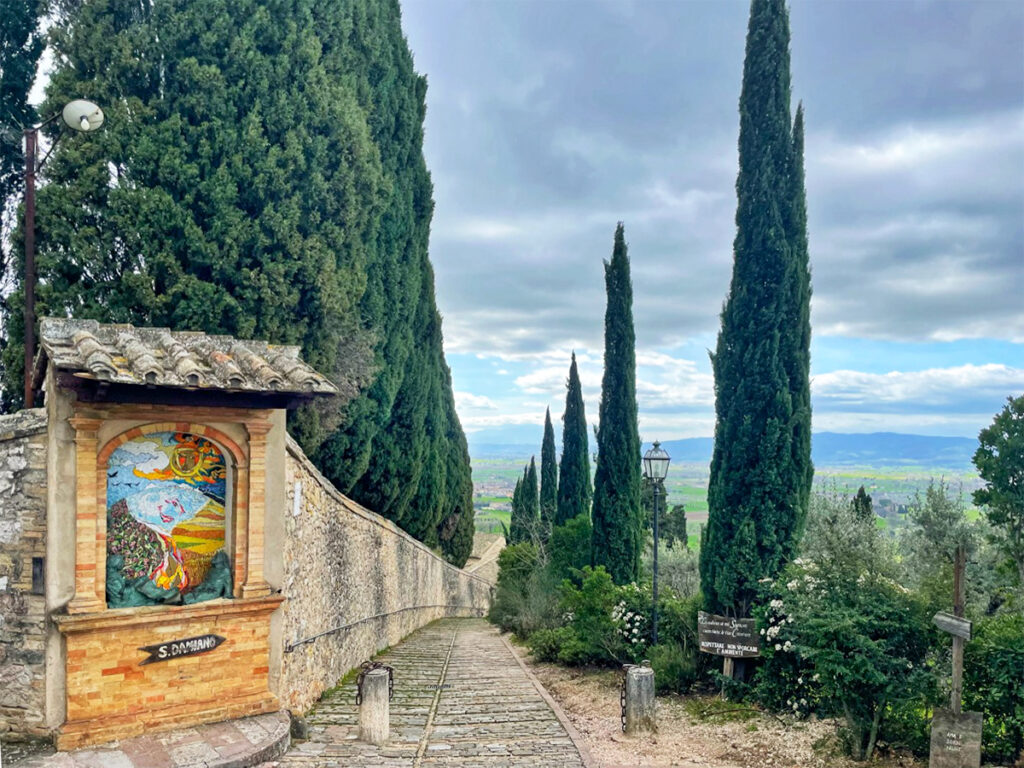
This rustic and charming 12th-century church and monastery is about a 15 min stroll downhill (and a slower waddle uphill on the way back) through Porta Nueva, past tranquil olive groves, towards the lush green Umbrian countryside of the valley of Tescio below.
It’s definitely worth the effort to walk here. Just make sure to check the opening time. The church might be closed between 12 and 2 pm.
How to Get to Assisi
Assisi is conveniently connected by train to Rome, Florence, Perugia and other major cities. The journey from Rome takes about 2 hours on a direct train and about 2.5 hours with a change at Foligno. You can check train schedules and buy your tickets online. The tickets bought online already have a date and time stamp and don’t need to be validated. You don’t even need to print your train tickets. If you download the Omio app, you can simply show your ticket in the app to the conductor.
Changing trains is quite simple and straightforward in Italy. Although if you are travelling with heavy luggage, keep in mind that smaller stations do not have escalators and you will probably have to carry your bags up and down the stairs when changing platforms.
Assisi train station is located in the valley, about 5km from the walled town. The taxi costs about 20 euros. There is also a bus (Line C) that will take you to the historic town centre. You can get your bus ticket at the little newsagent store inside the train station.
Where to Stay in Assisi – Quo Vadis
I stayed at the charming Quo Vadis and I couldn’t recommend this gorgeous hotel highly enough. Located in a historic palace, Quo Vadis is the perfect combination of modern-day creature comfort with a medieval ambience. My room had the most adorable view of medieval rooftops, both from the room and from the bathroom.
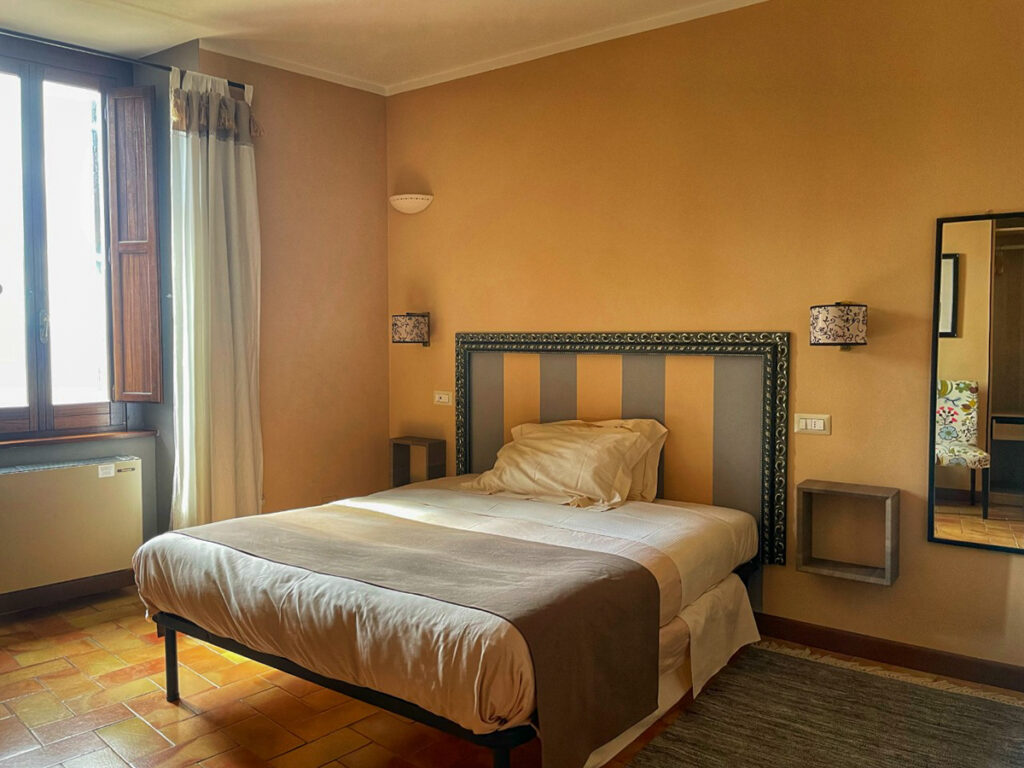
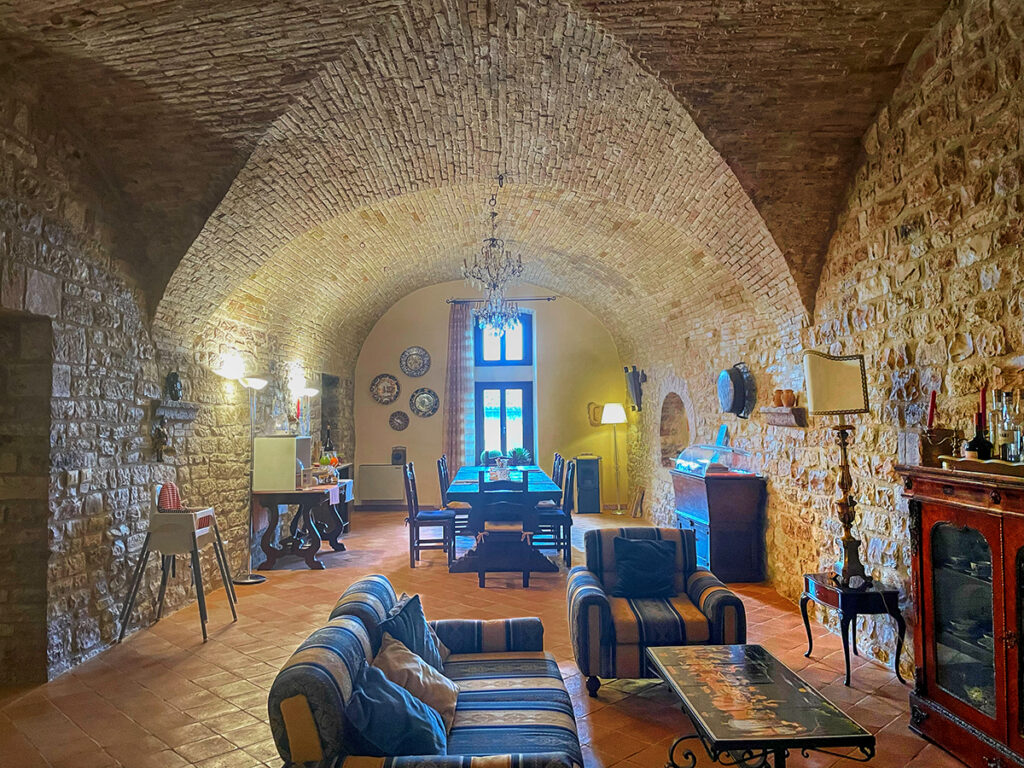
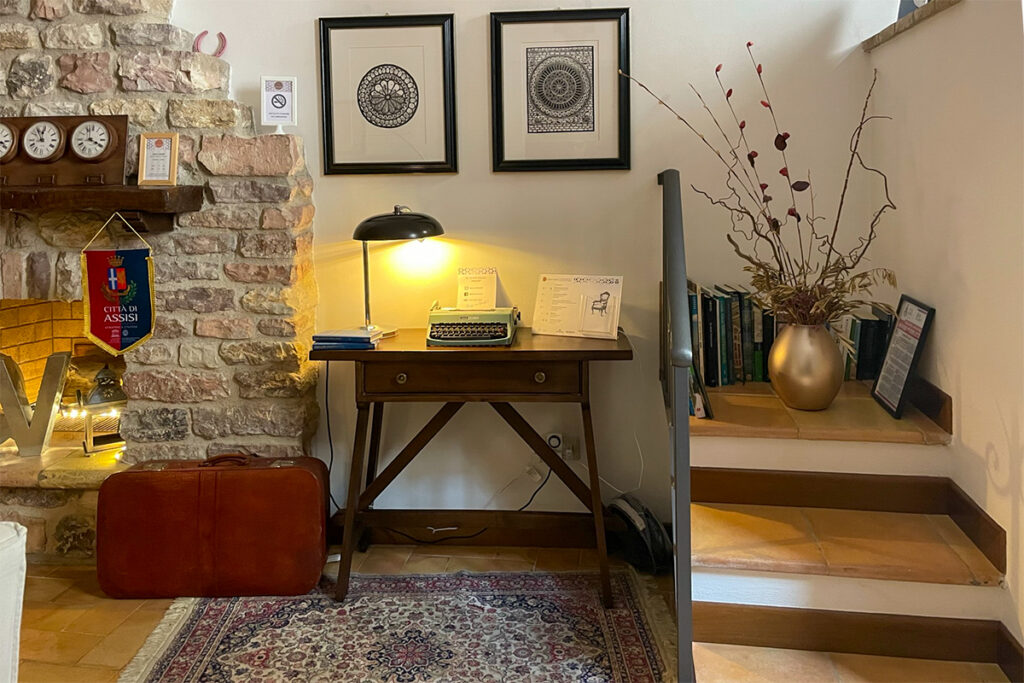
Quo Vadis feels and looks like a boutique hotel, but they let the rooms at a very affordable rate. Rachele is a wonderful host who will make you a fabulous home-cooked breakfast in a vaulted, medieval hall used as the dining room at Quo Vadis.
And to top it all off, Quo Vadis is located right next to San Rufino Cathedral and behind the hotel, you’ll find some of the architecturally most interesting medieval alleyways in Assisi. Honestly, I couldn’t imagine staying anywhere else in Assisi.
More on Exploring Italy
- Renaissance Cats in Florence – A Feline Lovers Guide to Florentine Renaissance Art

- 3 Days in Florence – Exploring the Cradle of the Renaissance
- 2 Days in Florence: Detailed and Flexible Itinerary & Tips
- 1 Day in Florence Itinerary – the Best of the Italian Renaissance

- Things to Do in Florence in Winter and Why Visit in Winter
- Leonardo da Vinci in Florence: In the Footsteps of the Renaissance Master

- Guide to Visiting Palazzo Vecchio: Must-see Art and Hidden Gems

- Medici Florence – a Self-Guided Walk in the Cradle of the Renaissance
- 18 Weekend Breaks in Italy: Top Destinations to Visit and Things to Do
- Quo Vadis – Assisi B&B Where Comfort Meets Medieval Charm



Honestly, I’d forgotten just how beautiful Italy is. And I’m pretty sure I’ve seen those streets and rooftops in a video game!
The pictures, the alleyways, your descriptions…it all makes me want to visit.
My friend spent 4 weeks in Assisi attending an Italian language school. She loved it. I was so jealous. I keep promising myself to visit. I am also a big fan of traveling down skinny lanes and alleys in foreign lands. Great post!
Assisi looks so so beautiful. Love those alleys with potted plants on the side. Just postcard perfect.
I love the vibrant skies on your pictures! Asissi is a place, that has been on my travel wish list for a pretty long time. I guess, in order to get such beautiful empty pics you have to get up really early. But this would be worth ist. I love visiting old churches and cathedrals – so I have to think about this trip again.
I’m not a great lover of towns, but when I do visit one, I appreciate those ancient ones with virtually no traffic because the roads just aren’t suitable for cars etc. And your comments about trains and tickets are particularly useful – my experience of them thirty years ago was somewhat confusing.
Perfect timing! I will be there for the first time in March. Saving to reference this awesome itinerary.
I lived in Città di Castello many moons ago and did a sightseeing trip to Assisi. It looks even more magical than before! Thank you for bringing back some great memories I’d not thought about in years!
Assisi has been on my list to visit since my friend took her Italian language classes. She described the city as wonderful to roam. I will save your post. It is excellent.
I’ve been to Italy several times but still haven’t made it to Assisi. It’s so high on my list though! There’s so much history here, and it seems like so a charming village. And I especially want to visit the cathedrals. Thank you for this great guide!